Browser Use logo

Browser Use

Organization
kontext-dev

Browse the web, directly from Cursor etc.

Publisherkontext-dev
Repositorybrowser-use-mcp-server
LanguagePython
Forks
107
Stars
822
Available tools
0
Transport typestdio
Categories
LicenseMIT
Links
  • Connect tools to AI workflows

    Browser Use exposes MCP capabilities that can be used by compatible AI clients and agents.

  • 0 available tools

    Browse the callable actions below, including names and descriptions when provided by the server.

  • Ready-to-copy setup

    Use the installation snippets to configure this server in your preferred MCP client.

  • Open source signals

    822 stars and 107 forks from the linked repository.

browser-use-mcp-server


Twitter URL Discord PyPI version

An MCP server that enables AI agents to control web browsers using browser-use.

🌐 Want to Vibe Browse the Web? Open-source AI-powered web browser - Vibe Browser.

🔗 Managing multiple MCP servers? Simplify your development workflow with agent-browser

Prerequisites

bash
# Install prerequisites
curl -LsSf https://astral.sh/uv/install.sh | sh
uv tool install mcp-proxy
uv tool update-shell

Environment

Create a .env file:

bash
OPENAI_API_KEY=your-api-key
CHROME_PATH=optional/path/to/chrome
PATIENT=false  # Set to true if API calls should wait for task completion

Installation

bash
# Install dependencies
uv sync
uv pip install playwright
uv run playwright install --with-deps --no-shell chromium

Usage

SSE Mode

bash
# Run directly from source
uv run server --port 8000

stdio Mode

bash
# 1. Build and install globally
uv build
uv tool uninstall browser-use-mcp-server 2>/dev/null || true

uv tool install dist/browser_use_mcp_server-*.whl

# 2. Run with stdio transport
browser-use-mcp-server run server --port 8000 --stdio --proxy-port 9000

Client Configuration

SSE Mode Client Configuration

json
{
  "mcpServers": {
    "browser-use-mcp-server": {
      "url": "http://localhost:8000/sse"
    }
  }
}

stdio Mode Client Configuration

json
{
  "mcpServers": {
    "browser-server": {
      "command": "browser-use-mcp-server",
      "args": [
        "run",
        "server",
        "--port",
        "8000",
        "--stdio",
        "--proxy-port",
        "9000"
      ],
      "env": {
        "OPENAI_API_KEY": "your-api-key"
      }
    }
  }
}

Config Locations

ClientConfiguration Path
Cursor./.cursor/mcp.json
Windsurf~/.codeium/windsurf/mcp_config.json
Claude (Mac)~/Library/Application Support/Claude/claude_desktop_config.json
Claude (Windows)%APPDATA%\Claude\claude_desktop_config.json

Features

  • Browser Automation: Control browsers through AI agents
  • Dual Transport: Support for both SSE and stdio protocols
  • VNC Streaming: Watch browser automation in real-time
  • Async Tasks: Execute browser operations asynchronously

Local Development

To develop and test the package locally:

  1. Build a distributable wheel:

    bash
    # From the project root directory
    uv build
  2. Install it as a global tool:

    bash
    uv tool uninstall browser-use-mcp-server 2>/dev/null || true
    uv tool install dist/browser_use_mcp_server-*.whl
  3. Run from any directory:

    bash
    # Set your OpenAI API key for the current session
    export OPENAI_API_KEY=your-api-key-here
    
    # Or provide it inline for a one-time run
    OPENAI_API_KEY=your-api-key-here browser-use-mcp-server run server --port 8000 --stdio --proxy-port 9000
  4. After making changes, rebuild and reinstall:

    bash
    uv build
    uv tool uninstall browser-use-mcp-server
    uv tool install dist/browser_use_mcp_server-*.whl

Docker

Using Docker provides a consistent and isolated environment for running the server.

bash
# Build the Docker image
docker build -t browser-use-mcp-server .

# Run the container with the default VNC password ("browser-use")
# --rm ensures the container is automatically removed when it stops
# -p 8000:8000 maps the server port
# -p 5900:5900 maps the VNC port
docker run --rm -p8000:8000 -p5900:5900 browser-use-mcp-server

# Run with a custom VNC password read from a file
# Create a file (e.g., vnc_password.txt) containing only your desired password
echo "your-secure-password" > vnc_password.txt
# Mount the password file as a secret inside the container
docker run --rm -p8000:8000 -p5900:5900 \
  -v $(pwd)/vnc_password.txt:/run/secrets/vnc_password:ro \
  browser-use-mcp-server

Note: The :ro flag in the volume mount (-v) makes the password file read-only inside the container for added security.

VNC Viewer

bash
# Browser-based viewer
git clone https://github.com/novnc/noVNC
cd noVNC
./utils/novnc_proxy --vnc localhost:5900

Default password: browser-use (unless overridden using the custom password method)

Example

Try asking your AI:

text
open https://news.ycombinator.com and return the top ranked article

Support

For issues or inquiries: cobrowser.xyz
Star History

Installation

TypingMind
Prerequisites:

Node.js 18+

{
  "mcpServers": {
    "browser-server": {
      "command": "browser-use-mcp-server",
      "args": [
        "run",
        "server",
        "--port",
        "8000",
        "--stdio",
        "--proxy-port",
        "9000"
      ],
      "env": {
        "OPENAI_API_KEY": "your-api-key"
      }
    }
  }
}

Use Browser Use MCP with multiple AI models

TypingMind connects MCP tools at the workspace level, so once Browser Use is connected, you can use it with different AI models in TypingMind instead of setting it up separately for each model. This MCP runs locally through the TypingMind MCP connector on your device.

Setup guide to use the local connector

Use this when the MCP server needs access to local files, apps, or private resources on your computer.

1

Open the MCP settings

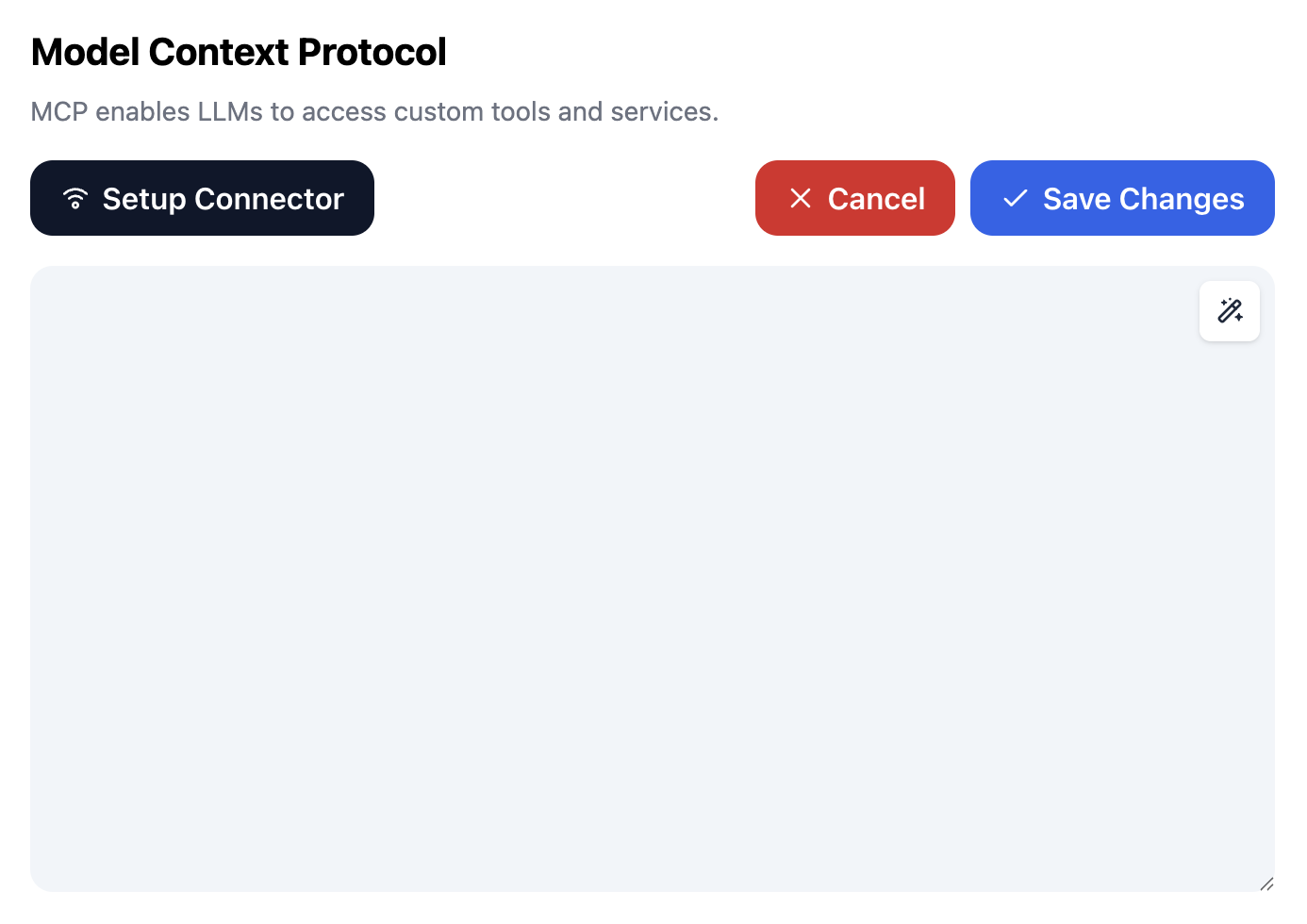
In TypingMind, go to Settings, Advanced Settings, then Model Context Protocol and choose Setup Connector.

  1. Open TypingMind in your browser.
  2. Click the Settings icon.
  3. Go to Advanced Settings.
  4. Open the Model Context Protocol section.
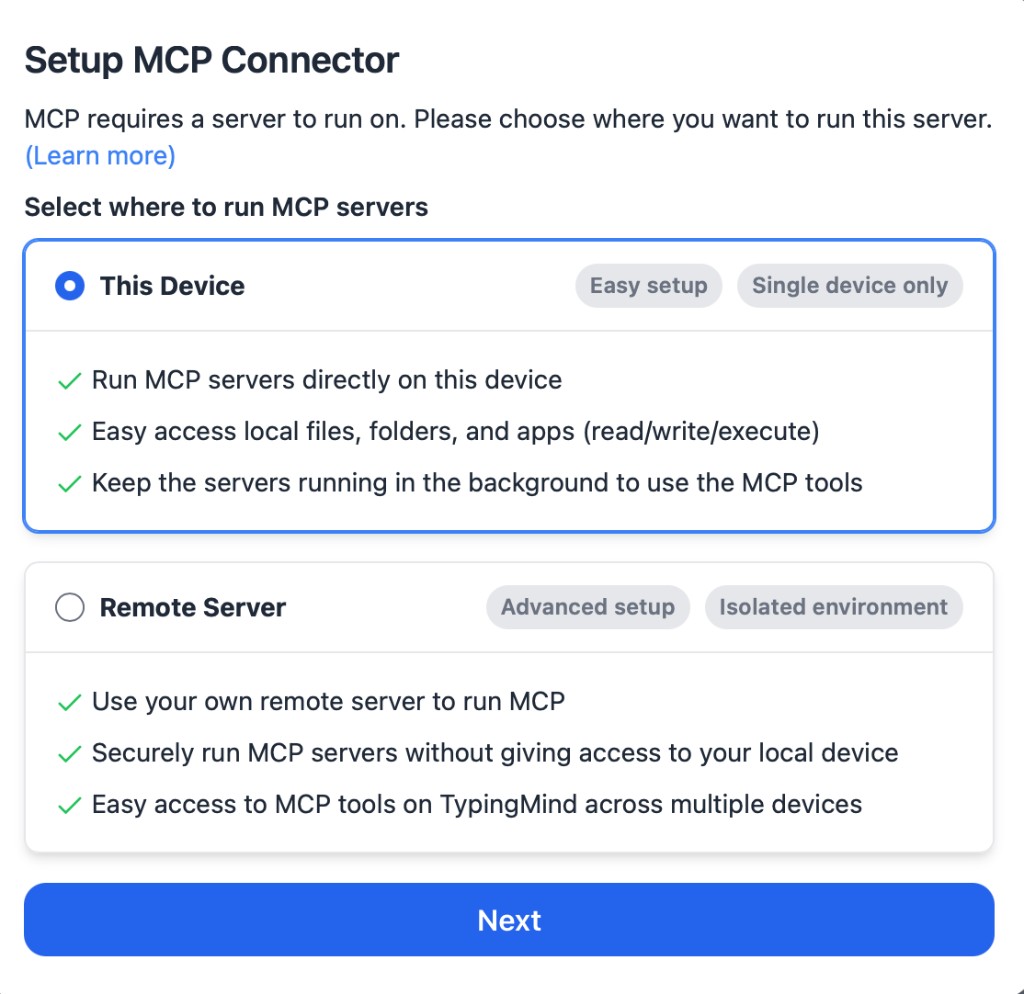
  5. Click Setup Connector and choose This Device.
TypingMind MCP connector setup screen with This Device selected
2

Run the connector command

Choose This Device, copy the command from TypingMind, and run it in Terminal. Keep the process running while you use MCP.

  1. Copy the setup command shown by TypingMind.
  2. Open Terminal on macOS or Windows Terminal on Windows.
  3. Paste and run the command.
  4. Approve the package install if Terminal asks you to proceed.
  5. Keep the Terminal window running while using MCP tools.
3

Add Browser Use as a server

When the connector status is Ready, click Edit Servers and paste the MCP server configuration.

  1. Wait until the connector status shows Ready.
  2. Click Edit Servers.
  3. Paste the Browser Use MCP server configuration.
  4. Save the server list.
  5. Refresh if you want to confirm the connector is still ready.
TypingMind MCP settings showing active server and Edit Servers button
{
  "mcpServers": {
    "browser-use": {
      "command": "npx",
      "args": [
        "-y",
        "browser-use-mcp-server"
      ]
    }
  }
}
4

Use it across models

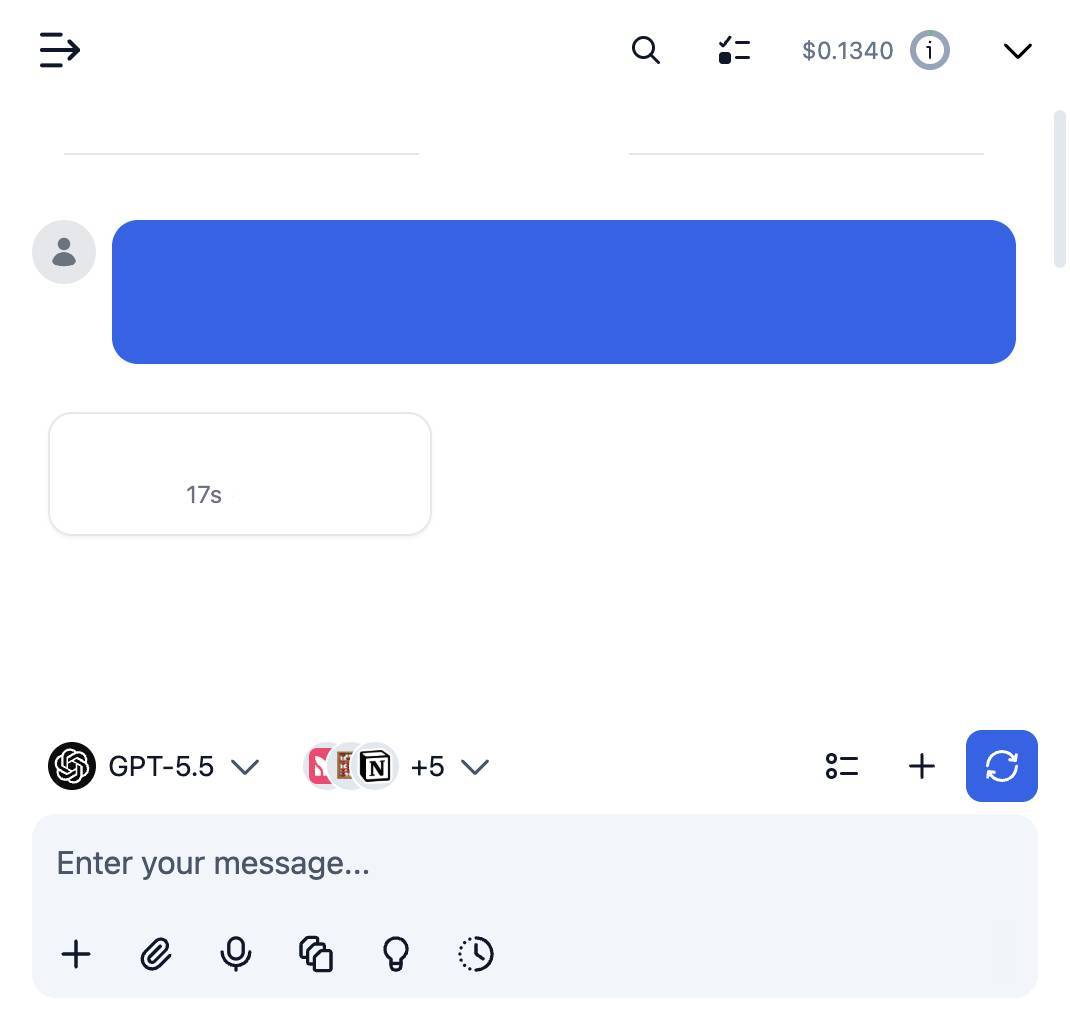
Save the server list, open Plugins, enable the Browser Use MCP tools, then select any supported AI model in TypingMind and use the tools in chat or assign them to an AI agent.

  1. Open the Plugins page in TypingMind.
  2. Enable the Browser Use MCP tools.
  3. Start a chat and choose the AI model you want to use.
  4. Use the MCP tools in chat or assign them to an AI agent.
  5. Switch to another AI model whenever needed without reconnecting MCP.
TypingMind chat using enabled MCP tools with a selected AI model
Can you use Browser Use to help me with this task?
Browser Use
Sure. I read it.
Here is what I found using Browser Use.

Frequently asked questions

What is the Browser Use MCP server used for?

Browser Use is an MCP server that lets compatible AI clients connect to external tools and context. In TypingMind, you can add this MCP server once and make its tools available in your AI workspace.

Can I use Browser Use MCP with multiple AI models in TypingMind?

Yes. TypingMind connects MCP tools at the workspace level, so you can use Browser Use with different AI models such as Claude, ChatGPT, Gemini, or other models you have configured in TypingMind without setting up the MCP server separately for each model.

Why use Browser Use MCP with TypingMind?

TypingMind is one of the best frontends for LLM chat because it brings multiple AI models, prompts, plugins, AI agents, API keys, and MCP tools into one workspace. With Browser Use connected, you can use its MCP tools across your preferred models while keeping your chat workflow organized in TypingMind.

How do I connect Browser Use MCP to TypingMind?

Browser Use runs through the TypingMind local MCP connector. This is best when the MCP server needs access to local files, desktop apps, command-line tools, or private resources on your computer.

What tools does Browser Use MCP provide in TypingMind?

Browser Use exposes MCP capabilities that can be enabled from the TypingMind Plugins page and used in chat or assigned to AI agents.

Do I need to share my API keys with TypingMind to use Browser Use MCP?

No. TypingMind is local-first and lets you keep your model providers, API keys, prompts, and MCP configuration under your control. If Browser Use requires authentication, add the required headers, OAuth settings, or local configuration for that MCP server when you create the connection.

Related MCP Servers

View all

Set up your own AI workspace now

Get notified about new features and future giveaways by subscribing to our newsletter 👇