ynab-mcp-server
A Model Context Protocol (MCP) server for interacting with your YNAB plans at https://ynab.com
In order to have an AI interact with this tool, you will need to get your Personal Access Token from YNAB: https://api.ynab.com/#personal-access-tokens. When adding this MCP server to any client, you will need to provide your personal access token as YNAB_API_TOKEN. This token is never directly sent to the LLM. It is stored privately in an environment variable for use with the YNAB api.
A Model Context Protocol server that lets an AI assistant read and modify a YNAB plan.
The server talks to the YNAB API through the official
ynab SDK. Your Personal Access Token
lives in an environment variable and is never sent to the model.
It runs two ways from one codebase:
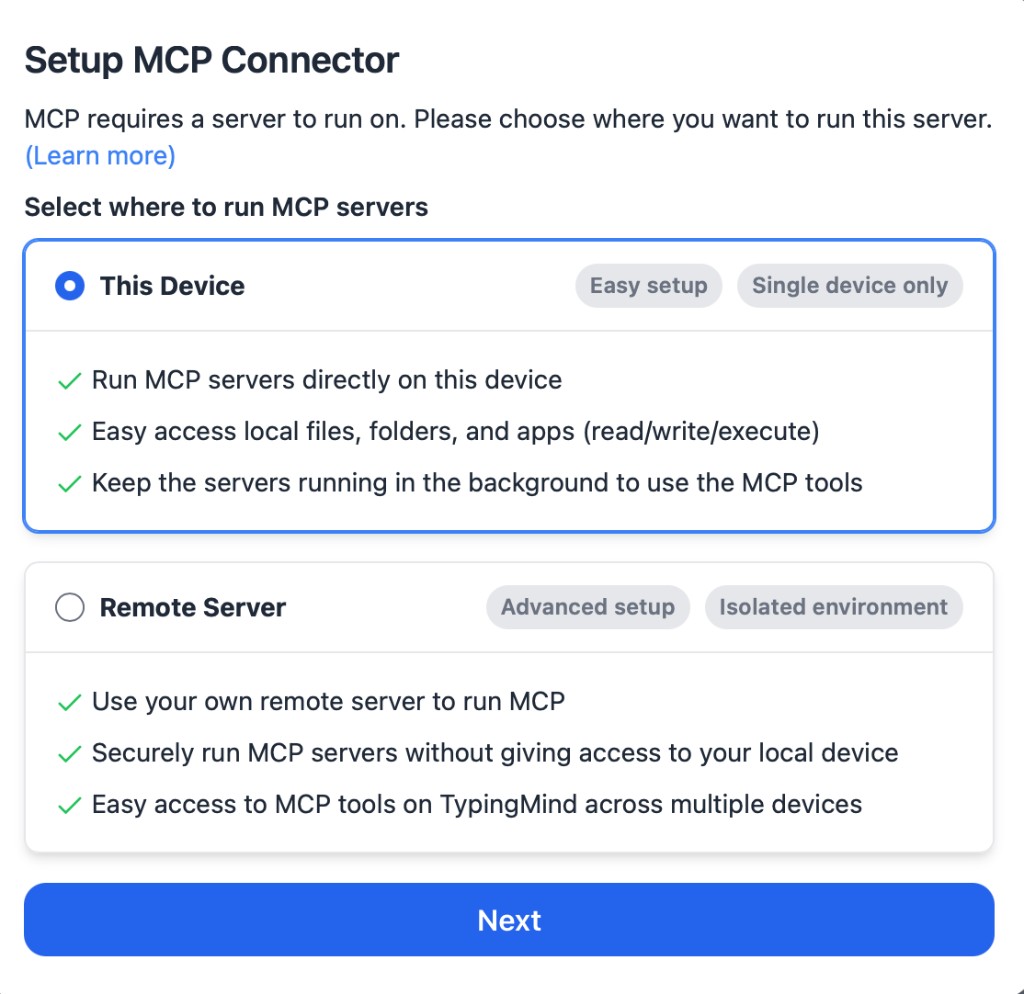
- Local (stdio) — a child process of Claude Code or Claude Desktop on your own machine. Simplest, but only works on that machine while it is running.
- Remote (Cloudflare Worker) — deployed behind GitHub sign-in and added to claude.ai as a custom connector, so it works from the web and the mobile app with your computer switched off. See DEPLOY.md.
Both entry points register the same tools from src/registry.ts, so a tool
written once is available in both.
Other providers:
Setup
Get a Personal Access Token from https://api.ynab.com/#personal-access-tokens, then:
bashnpm install npm run build
Environment variables:
| Variable | Required | Purpose |
|---|---|---|
YNAB_API_TOKEN | yes | Personal Access Token used for every API call |
YNAB_PLAN_ID | no | Default plan, so tools can omit planId. Find it with ynab_list_plans. |
TYPESAFE_API_KEY | no | Operator-owned TypeSafe credential. Required, but not sufficient, to enable category suggestions. |
YNAB_AI_CATEGORIZATION | no | Set to "true" together with TYPESAFE_API_KEY to expose the opt-in suggestion tool. |
Local: Claude Desktop / Claude Code
json{ "mcpServers": { "ynab": { "command": "node", "args": ["/absolute/path/to/ynab-mcp-server/dist/index.js"], "env": { "YNAB_API_TOKEN": "your-token", "YNAB_PLAN_ID": "your-plan-id" } } } }
Remote: phone and claude.ai
The stdio server above cannot be reached from a phone. To use these tools from
claude.ai or the Claude mobile app, deploy src/worker/ to Cloudflare Workers
and add it as a custom connector. DEPLOY.md has the full walk
through; the shape of it:
- Copy
wrangler.example.jsoncto the git-ignoredwrangler.jsonc, runnpx wrangler login, then create theOAUTH_KVnamespace npm run deployonce to learn your*.workers.devhostname- Create a GitHub OAuth app whose callback is
https://<host>/callback - Use
npx wrangler secret putforALLOWED_GITHUB_LOGIN,YNAB_API_TOKEN,GITHUB_CLIENT_ID,GITHUB_CLIENT_SECRET, andTYPESAFE_API_KEY - Run
npm run deployagain - Add
https://<host>/mcpas a custom connector in claude.ai
The YNAB token stays a Worker secret and never reaches the client. GitHub sign-in
controls who may connect to the remote Worker; the YNAB Personal Access
Token controls which YNAB account it reaches. They answer different
questions, and neither substitutes for the other. The Worker uses one
server-wide YNAB token, so anyone admitted through the GitHub gate reaches the
deployer's YNAB account, money, and every plan available to that token—not
their own YNAB account.
ynab_list_plans lists all of those plans, and a caller-supplied planId
overrides the optional YNAB_PLAN_ID default. Any GitHub account other than
ALLOWED_GITHUB_LOGIN is refused. This matters because the tool set can create
and delete transactions—an unauthenticated endpoint would grant access to those
plans to anyone who found the URL.
Why not YNAB OAuth?
YNAB OAuth is deliberately not supported. Its token exchange requires a client secret even with PKCE; an open-source package cannot ship a secret, so a local package cannot honestly implement the authorization-code flow (OAuth application requirements). The only secretless flow YNAB documents is the implicit grant, which expires in two hours with no refresh (OAuth application requirements). YNAB recommends a Personal Access Token for an individual accessing their own account (Personal Access Tokens).
Setting YNAB_READ_ONLY to "true" drops every write tool from the tool list,
which is worth considering for a connector you will mostly use on a phone.
Tools
Plan-scoped tools take an optional planId that falls back to
YNAB_PLAN_ID. Optional tool inputs may be null; the server treats null
the same as omitting that input. All monetary values — in both directions — are
plain currency amounts, never YNAB's milliunits; conversion happens in
src/tools/money.ts.
Reading
| Tool | What it does |
|---|---|
ynab_list_plans | Every plan on the account. Run this first to find a plan ID. |
ynab_plan_summary | A month at a glance: income, budgeted, activity, Ready to Assign, plus categories split into overspent, underfunded (goal not yet met) and positive_balance. Hidden and deleted categories are excluded. |
ynab_list_accounts | Accounts with balances. includeClosedAccounts to see closed ones. |
ynab_list_categories | Categories grouped by category group, with goal info. |
ynab_list_payees | Payees, for resolving payee IDs. |
ynab_list_months | Every plan month with its summary numbers. |
ynab_list_scheduled_transactions | Scheduled/recurring transactions. |
ynab_get_transactions | Transactions filtered by sinceDate, accountId, categoryId, payeeId, type (all/uncategorized/unapproved) and limit (default 100). |
ynab_get_unapproved_transactions | Unapproved transactions, optionally from sinceDate onward. |
ynab_suggest_categories | Opt-in, read-only category previews for unapproved, uncategorized ordinary outflows. Deleted and categorized rows are dropped in default mode; approved, reconciled, balance-adjustment, transfer, split, and inflow rows are skipped as applicable. |
Category suggestions (optional)
ynab_apply_category_suggestions is a separate write tool that is available
without enabling the TypeSafe preview. Provide up to 25 explicit
transaction_id, category_id, and expected_content_fingerprint rows. The
tool refetches each transaction and rejects stale or ineligible changes; a retry
whose category is already applied is a no-op. It supports validation-only dry
runs and returns a pre-write undo manifest, but does not perform the undo. It
never auto-applies suggestions, calls TypeSafe, or approves transactions.
ynab_suggest_categories is off by default. To expose it, set both an
operator-owned TYPESAFE_API_KEY and YNAB_AI_CATEGORIZATION=true, then restart
the server. The API key is read from the environment (or a Worker secret), never
from a tool argument. Omit transactionIds, pass null, or pass an empty
array to fetch unapproved transactions and retain only uncategorized rows;
provide IDs to inspect only those transactions. In default mode, the tool
checks every retained row for deterministic eligibility and then applies
limit to the first eligible outflows in YNAB's returned order. Skipped rows
do not consume the limit.
The tool is a dry-run preview: it never writes to YNAB, approves a transaction,
or changes the behavior of ynab_update_transaction. It first handles exact
facts in code—dropping deleted rows and handling approved or reconciled rows,
YNAB balance adjustments, transfers, splits, inflows, existing categories, and
hidden/internal categories. In default mode, transactions contains only the
eligible rows inspected, transaction_count is that row count, and
eligible_transaction_count reports all eligible rows available before the
limit. The top-level skipped object reports total_count and a count plus
transaction_ids for each reason: skipped_approved, skipped_reconciled,
skipped_balance_adjustment, skipped_transfer, skipped_split,
skipped_inflow, and skipped_already_categorized. With explicit
transactionIds, every non-deleted fetched row remains an individual result,
including rows carrying a skipped_* status; deleted rows are omitted.
Payee history uses the latest 12 months, capped at 50 qualifying exact-payee
rows. The history rule applies only when at least three such rows all use the
same still-eligible category; every eligible row without that unanimous signal
goes to TypeSafe's pinned jev-1.13.0 System One model in batches of ten. Any
disagreement between the history plurality and the model forces
needs_review. Every inspected eligible row includes a status, content
fingerprint, proposed category, confidence, winning probability, up to three
alternatives, and history summary. Applying a suggestion remains a separate,
explicit human decision using ynab_apply_category_suggestions (or the general
ynab_update_transaction tool).
Enabling this feature sends the transaction's display payee, imported/original payee, memo, amount, date, and account name/type/on-budget status, plus visible category group and category names, to TypeSafe as a third-party processor. It does not send YNAB UUIDs, balances, goals, approval/cleared state, or raw transaction history. TypeSafe's published Jev 1.13 price at the time of this release is $0.042 per million input tokens; output tokens are free. The tool returns preflight estimates, actual token usage, and projected cost on each run and refuses requests over its per-call token/cost ceilings. Pricing and provider limits can change; check https://docs.typesafe.ai/models.
The prototype is intentionally narrow and not default-on. Its supporting 98.3% exact-label, 98.9% top-three, and 60/60 expected-abstention results came from 40 synthetic, single-evaluator fixtures—not a production accuracy claim.
Reporting
Splits are counted through their subtransactions and transfers between your own accounts are excluded, so these report spending rather than money movement.
| Tool | What it does |
|---|---|
ynab_spending_by_category | Total spend per category over a date range, biggest first, with share of total. Defaults to the last 30 days. |
ynab_spending_by_payee | The same, grouped by merchant. |
ynab_cash_flow | Income vs spending per month with the running net, from YNAB's own monthly totals. Defaults to the last 6 months. |
Writing
| Tool | What it does |
|---|---|
ynab_create_transaction | Creates a transaction. Needs date, amount, an account (accountId or accountName) and a payee (payeeId or payeeName); category optional as categoryId or categoryName. |
ynab_update_transaction | Updates any subset of an existing transaction's fields. |
ynab_delete_transaction | Deletes a transaction. Not undoable. |
ynab_approve_transaction | Approves (or un-approves) one transaction. |
ynab_bulk_approve_transactions | Approves an array of transaction IDs in one API call. |
ynab_apply_category_suggestions | Applies up to 25 explicit category suggestions with refetch and stale-data checks, dry-run support, and a pre-write undo manifest. Never auto-applies or approves transactions. |
ynab_update_category_budget | Sets the total budgeted amount for a category in a month. Not an increment. |
ynab_import_transactions | Triggers an import from linked institutions, the same as hitting Import in the YNAB app. |
ynab_move_money | Moves budgeted money between two categories in a month, for covering overspending. |
ynab_auto_assign | Spreads Ready to Assign over categories with unmet monthly goals, largest shortfall first. dryRun to preview, maxTotal to cap it. |
Names instead of IDs
ynab_create_transaction accepts accountName and categoryName and matches
them loosely against the plan, so "ally checking" finds Ally Checking.
Closed accounts and hidden categories are never matched. If a name is ambiguous
or unrecognised the call fails and names the near misses rather than guessing,
and successful calls echo back matchedAccount / matchedCategory so a wrong
guess is visible.
Writes that can half-succeed
YNAB has no endpoint for moving money between categories, so ynab_move_money
rewrites both categories' budgeted amounts in two calls. It takes from the
source first, so a failure in between leaves the money in Ready to Assign rather
than double-counted. When that happens the response sets partial: true and
carries a recovery line with the original amount to restore. ynab_auto_assign
behaves the same way: on failure it reports which categories were already funded
and which were left alone.
Tools never throw at the protocol level. Failures come back as an MCP error
result (isError: true) with { "success": false, "error": "..." } in the
text content, so a failed write is never mistaken for a successful one.
Tool annotations
Every tool advertises MCP annotations (readOnlyHint, destructiveHint,
idempotentHint, openWorldHint) alongside its schema. Reading tools are
readOnlyHint: true; among the writing tools, only ynab_delete_transaction
sets destructiveHint: true. A client may use these hints to decide which
calls need a confirmation prompt.
cleared and flagColor
ynab_create_transaction and ynab_update_transaction accept cleared as
one of cleared, uncleared, or reconciled, and flagColor as one of
red, orange, yellow, green, blue, purple, or "" to clear an
existing flag.
Development
bashnpm run watch # rebuild on change npm test # vitest (watch mode) npm run test:run # vitest, single run npm run test:coverage # coverage report npm run typecheck # typecheck both the node and Worker targets npm run debug # build, then open the MCP inspector npm run dev:worker # run the Worker locally with wrangler npm run deploy # deploy the Worker to Cloudflare
dist/ is a build artifact and is not tracked in git; npm run build regenerates it.
Releasing
Bump the version in package.json and update CHANGELOG.md, then merge to main and create a GitHub release tagged in the existing 0.2.0 style (without a v prefix). The workflow stages that release with npm; it does not make the package public. The maintainer must run npm stage list, review it, and run npm stage approve with 2FA to promote it live. Configure a Trusted Publisher on npmjs.com for ynab-mcp-server, pointing at GitHub repository calebl/ynab-mcp-server and the exact workflow filename .github/workflows/publish.yml (the filename must match exactly); under Allowed actions select only npm stage publish.
Adding a tool
Each tool is a self-contained module in src/tools/ exporting name,
description, inputSchema (a Zod shape) and execute(input, api). See
CLAUDE.md for the full template, then add the module to the tools array in
src/registry.ts and write a test in src/tests/. Registering it there serves
it from both the stdio server and the Worker; mark writes: true if the tool
changes data, which is what YNAB_READ_ONLY filters on.
Useful references:
- YNAB SDK types:
node_modules/ynab/dist/index.d.ts - YNAB OpenAPI spec: https://api.ynab.com/papi/open_api_spec.yaml
Compatibility
ynab_list_budgets and ynab_budget_summary remain accepted aliases for the
plan-named tools. budgetId and YNAB_BUDGET_ID are deprecated but still
accepted; there is no removal date. Use planId and YNAB_PLAN_ID for new
integrations.
License
See LICENSE.