MCP Server Chart logo

MCP Server Chart

OrganizationPopular
antvis

🤖 A visualization mcp & skills contains 25+ visual charts using @antvis. Using for chart generation and data analysis.

Publisherantvis
Repositorymcp-server-chart
LanguageTypeScript
Forks
377
Stars
4.1K
Available tools
26
Transport typestdio, streamable-http
Categories
LicenseMIT
Links
  • Connect tools to AI workflows

    MCP Server Chart exposes MCP capabilities that can be used by compatible AI clients and agents.

  • 26 available tools

    Browse the callable actions below, including names and descriptions when provided by the server.

  • Ready-to-copy setup

    Use the installation snippets to configure this server in your preferred MCP client.

  • Open source signals

    4.1K stars and 377 forks from the linked repository.

MCP Server Chart

A Model Context Protocol server for generating charts using AntV. We can use this mcp server for chart generation and data analysis.

build npm Version npm License codecov smithery installations badge Visitors

This is a TypeScript-based MCP server that provides chart generation capabilities. It allows you to create various types of charts through MCP tools. You can also use it in Dify.

📋 Table of Contents

✨ Features

Now 26+ charts supported.

  1. generate_area_chart: Generate an area chart, used to display the trend of data under a continuous independent variable, allowing observation of overall data trends.
  2. generate_bar_chart: Generate a bar chart, used to compare values across different categories, suitable for horizontal comparisons.
  3. generate_boxplot_chart: Generate a boxplot, used to display the distribution of data, including the median, quartiles, and outliers.
  4. generate_column_chart: Generate a column chart, used to compare values across different categories, suitable for vertical comparisons.
  5. generate_district_map - Generate a district-map, used to show administrative divisions and data distribution.
  6. generate_dual_axes_chart: Generate a dual-axes chart, used to display the relationship between two variables with different units or ranges.
  7. generate_fishbone_diagram: Generate a fishbone diagram, also known as an Ishikawa diagram, used to identify and display the root causes of a problem.
  8. generate_flow_diagram: Generate a flowchart, used to display the steps and sequence of a process.
  9. generate_funnel_chart: Generate a funnel chart, used to display data loss at different stages.
  10. generate_histogram_chart: Generate a histogram, used to display the distribution of data by dividing it into intervals and counting the number of data points in each interval.
  11. generate_line_chart: Generate a line chart, used to display the trend of data over time or another continuous variable.
  12. generate_liquid_chart: Generate a liquid chart, used to display the proportion of data, visually representing percentages in the form of water-filled spheres.
  13. generate_mind_map: Generate a mind-map, used to display thought processes and hierarchical information.
  14. generate_network_graph: Generate a network graph, used to display relationships and connections between nodes.
  15. generate_organization_chart: Generate an organizational chart, used to display the structure of an organization and personnel relationships.
  16. generate_path_map - Generate a path-map, used to display route planning results for POIs.
  17. generate_pie_chart: Generate a pie chart, used to display the proportion of data, dividing it into parts represented by sectors showing the percentage of each part.
  18. generate_pin_map - Generate a pin-map, used to show the distribution of POIs.
  19. generate_radar_chart: Generate a radar chart, used to display multi-dimensional data comprehensively, showing multiple dimensions in a radar-like format.
  20. generate_sankey_chart: Generate a sankey chart, used to display data flow and volume, representing the movement of data between different nodes in a Sankey-style format.
  21. generate_scatter_chart: Generate a scatter plot, used to display the relationship between two variables, showing data points as scattered dots on a coordinate system.
  22. generate_treemap_chart: Generate a treemap, used to display hierarchical data, showing data in rectangular forms where the size of rectangles represents the value of the data.
  23. generate_venn_chart: Generate a venn diagram, used to display relationships between sets, including intersections, unions, and differences.
  24. generate_violin_chart: Generate a violin plot, used to display the distribution of data, combining features of boxplots and density plots to provide a more detailed view of the data distribution.
  25. generate_word_cloud_chart: Generate a word-cloud, used to display the frequency of words in textual data, with font sizes indicating the frequency of each word.
  26. generate_spreadsheet: Generate a spreadsheet or pivot table for displaying tabular data. When 'rows' or 'values' fields are provided, it renders as a pivot table (cross-tabulation); otherwise, it renders as a regular table.

[!NOTE] The above geographic visualization chart generation tool uses AMap service and currently only supports map generation within China.

🤖 Usage

To use with Desktop APP, such as Claude, VSCode, Cline, Cherry Studio, Cursor, and so on, add the MCP server config below. On Mac system:

json
{
  "mcpServers": {
    "mcp-server-chart": {
      "command": "npx",
      "args": ["-y", "@antv/mcp-server-chart"]
    }
  }
}

On Window system:

json
{
  "mcpServers": {
    "mcp-server-chart": {
      "command": "cmd",
      "args": ["/c", "npx", "-y", "@antv/mcp-server-chart"]
    }
  }
}

Also, you can use it on aliyun, modelscope, glama.ai, smithery.ai or others with HTTP, SSE Protocol.

🎨 Skill Usage

If you are using an AI IDE with skill support (like Claude Code), you can use the chart-visualization skill to automatically select the best chart type and generate visualizations.

You can add the skill from https://github.com/antvis/chart-visualization-skills using:

bash
npx skills add antvis/chart-visualization-skills

Then provide your data or describe the visualization you want. The skill will intelligently choose from 25+ chart types and generate the chart for you.

🚰 Run with SSE or Streamable transport

Run directly

Install the package globally.

bash
npm install -g @antv/mcp-server-chart

Run the server with your preferred transport option:

bash
# For SSE transport (default endpoint: /sse)
mcp-server-chart --transport sse

# For Streamable transport with custom endpoint
mcp-server-chart --transport streamable

Then you can access the server at:

  • SSE transport: http://localhost:1122/sse
  • Streamable transport: http://localhost:1122/mcp

Docker deploy

Enter the docker directory.

bash
cd docker

Deploy using docker-compose.

bash
docker compose up -d

Then you can access the server at:

  • SSE transport: http://localhost:1123/sse
  • Streamable transport: http://localhost:1122/mcp

🎮 CLI Options

You can also use the following CLI options when running the MCP server. Command options by run cli with -H.

plain
MCP Server Chart CLI

Options:
  --transport, -t  Specify the transport protocol: "stdio", "sse", or "streamable" (default: "stdio")
  --host, -h       Specify the host for SSE or streamable transport (default: localhost)
  --port, -p       Specify the port for SSE or streamable transport (default: 1122)
  --endpoint, -e   Specify the endpoint for the transport:
                   - For SSE: default is "/sse"
                   - For streamable: default is "/mcp"
  --help, -H       Show this help message

⚙️ Environment Variables

VariableDescriptionDefaultExample
VIS_REQUEST_SERVERCustom chart generation service URL for private deploymenthttps://antv-studio.alipay.com/api/gpt-vishttps://your-server.com/api/chart
SERVICE_IDService identifier for chart generation records-your-service-id-123
DISABLED_TOOLSComma-separated list of tool names to disable-generate_fishbone_diagram,generate_mind_map

📠 Private Deployment

MCP Server Chart provides a free chart generation service by default. For users with a need for private deployment, they can try using VIS_REQUEST_SERVER to customize their own chart generation service.

json
{
  "mcpServers": {
    "mcp-server-chart": {
      "command": "npx",
      "args": ["-y", "@antv/mcp-server-chart"],
      "env": {
        "VIS_REQUEST_SERVER": "<YOUR_VIS_REQUEST_SERVER>"
      }
    }
  }
}

You can use AntV's project GPT-Vis-SSR to deploy an HTTP service in a private environment, and then pass the URL address through env VIS_REQUEST_SERVER.

  • Method: POST
  • Parameter: Which will be passed to GPT-Vis-SSR for rendering. Such as, { "type": "line", "data": [{ "time": "2025-05", "value": 512 }, { "time": "2025-06", "value": 1024 }] }.
  • Return: The return object of HTTP service.
    • success: boolean Whether generate chart image successfully.
    • resultObj: string The chart image url.
    • errorMessage: string When success = false, return the error message.

[!NOTE] The private deployment solution currently does not support geographic visualization chart generation include 3 tools: geographic-district-map, geographic-path-map, geographic-pin-map.

🗺️ Generate Records

By default, users are required to save the results themselves, but we also provide a service for viewing the chart generation records, which requires users to generate a service identifier for themselves and configure it.

Use Alipay to scan and open the mini program to generate a personal service identifier (click the "My" menu below, enter the "My Services" page, click the "Generate" button, and click the "Copy" button after success):

Next, you need to add the SERVICE_ID environment variable to the MCP server configuration. For example, the configuration for Mac is as follows (for Windows systems, just add the env variable):

json
{
  "mcpServers": {
    "AntV Map": {
      "command": "npx",
      "args": ["-y", "@antv/mcp-server-chart"],
      "env": {
        "SERVICE_ID": "***********************************"
      }
    }
  }
}

After updating the MCP Server configuration, you need to restart your AI client application and check again whether you have started and connected to the MCP Server successfully. Then you can try to generate the map again. After the generation is successful, you can go to the "My Map" page of the mini program to view your map generation records.

🎛️ Tool Filtering

You can disable specific chart generation tools using the DISABLED_TOOLS environment variable. This is useful when certain tools have compatibility issues with your MCP client or when you want to limit the available functionality.

json
{
  "mcpServers": {
    "mcp-server-chart": {
      "command": "npx",
      "args": ["-y", "@antv/mcp-server-chart"],
      "env": {
        "DISABLED_TOOLS": "generate_fishbone_diagram,generate_mind_map"
      }
    }
  }
}

Available tool names for filtering See the ✨ Features.

🔨 Development

Install dependencies:

bash
npm install

Build the server:

bash
npm run build

Start the MCP server:

bash
npm run start

Start the MCP server with SSE transport:

bash
node build/index.js -t sse

Start the MCP server with Streamable transport:

bash
node build/index.js -t streamable

📄 License

MIT@AntV.
Installation

TypingMind
Prerequisites:

Node.js 18+

{
  "mcpServers": {
    "mcp-server-chart": {
      "command": "npx",
      "args": [
        "-y",
        "@antv/mcp-server-chart"
      ]
    }
  }
}

Available Tools

  • generate_area_chart

    Generate a area chart to show data trends under continuous independent variables and observe the overall data trend, such as, displacement = velocity (average or instantaneous) × time: s = v × t. If the x-axis is time (t) and the y-axis is velocity (v) at each moment, an area chart allows you to observe the trend of velocity over time and infer the distance traveled by the area's size.

  • generate_bar_chart

    Generate a horizontal bar chart to show data for numerical comparisons among different categories, such as, comparing categorical data and for horizontal comparisons.

  • generate_boxplot_chart

    Generate a boxplot chart to show data for statistical summaries among different categories, such as, comparing the distribution of data points across categories.

  • generate_column_chart

    Generate a column chart, which are best for comparing categorical data, such as, when values are close, column charts are preferable because our eyes are better at judging height than other visual elements like area or angles.

  • generate_district_map

    Generates regional distribution maps, which are usually used to show the administrative divisions and coverage of a dataset. It is not suitable for showing the distribution of specific locations, such as urban administrative divisions, GDP distribution maps of provinces and cities across the country, etc. This tool is limited to generating data maps within China.

  • generate_dual_axes_chart

    Generate a dual axes chart which is a combination chart that integrates two different chart types, typically combining a bar chart with a line chart to display both the trend and comparison of data, such as, the trend of sales and profit over time.

  • generate_fishbone_diagram

    Generate a fishbone diagram chart to uses a fish skeleton, like structure to display the causes or effects of a core problem, with the problem as the fish head and the causes/effects as the fish bones. It suits problems that can be split into multiple related factors.

  • generate_flow_diagram

    Generate a flow diagram chart to show the steps and decision points of a process or system, such as, scenarios requiring linear process presentation.

  • generate_funnel_chart

    Generate a funnel chart to visualize the progressive reduction of data as it passes through stages, such as, the conversion rates of users from visiting a website to completing a purchase.

  • generate_histogram_chart

    Generate a histogram chart to show the frequency of data points within a certain range. It can observe data distribution, such as, normal and skewed distributions, and identify data concentration areas and extreme points.

  • generate_line_chart

    Generate a line chart to show trends over time, such as, the ratio of Apple computer sales to Apple's profits changed from 2000 to 2016.

  • generate_liquid_chart

    Generate a liquid chart to visualize a single value as a percentage, such as, the current occupancy rate of a reservoir or the completion percentage of a project.

  • generate_mind_map

    Generate a mind map chart to organizes and presents information in a hierarchical structure with branches radiating from a central topic, such as, a diagram showing the relationship between a main topic and its subtopics.

  • generate_network_graph

    Generate a network graph chart to show relationships (edges) between entities (nodes), such as, relationships between people in social networks.

  • generate_organization_chart

    Generate an organization chart to visualize the hierarchical structure of an organization, such as, a diagram showing the relationship between a CEO and their direct reports.

  • generate_path_map

    Generate a route map to display the user's planned route, such as travel guide routes.

  • generate_pie_chart

    Generate a pie chart to show the proportion of parts, such as, market share and budget allocation.

  • generate_pin_map

    Generate a point map to display the location and distribution of point data on the map, such as the location distribution of attractions, hospitals, supermarkets, etc.

  • generate_radar_chart

    Generate a radar chart to display multidimensional data (four dimensions or more), such as, evaluate Huawei and Apple phones in terms of five dimensions: ease of use, functionality, camera, benchmark scores, and battery life.

  • generate_sankey_chart

    Generate a sankey chart to visualize the flow of data between different stages or categories, such as, the user journey from landing on a page to completing a purchase.

  • generate_scatter_chart

    Generate a scatter chart to show the relationship between two variables, helps discover their relationship or trends, such as, the strength of correlation, data distribution patterns.

  • generate_treemap_chart

    Generate a treemap chart to display hierarchical data and can intuitively show comparisons between items at the same level, such as, show disk space usage with treemap.

  • generate_venn_chart

    Generate a Venn diagram to visualize the relationships between different sets, showing how they intersect and overlap, such as the commonalities and differences between various groups.

  • generate_violin_chart

    Generate a violin chart to show data for statistical summaries among different categories, such as, comparing the distribution of data points across categories.

  • generate_word_cloud_chart

    Generate a word cloud chart to show word frequency or weight through text size variation, such as, analyzing common words in social media, reviews, or feedback.

  • generate_waterfall_chart

    Generate a waterfall chart to visualize the cumulative effect of sequentially introduced positive or negative values, such as showing how an initial value is affected by a series of intermediate positive or negative values leading to a final result. Waterfall charts are ideal for financial analysis, budget tracking, profit and loss statements, and understanding the composition of changes over time or categories.

Use MCP Server Chart MCP with multiple AI models

TypingMind connects MCP tools at the workspace level, so once MCP Server Chart is connected, you can use it with different AI models in TypingMind instead of setting it up separately for each model. You can run MCP locally on your device or connect to a remote MCP server URL.

Option 1: Use the local connector

Use this when the MCP server needs access to local files, apps, or private resources on your computer.

1

Open the MCP settings

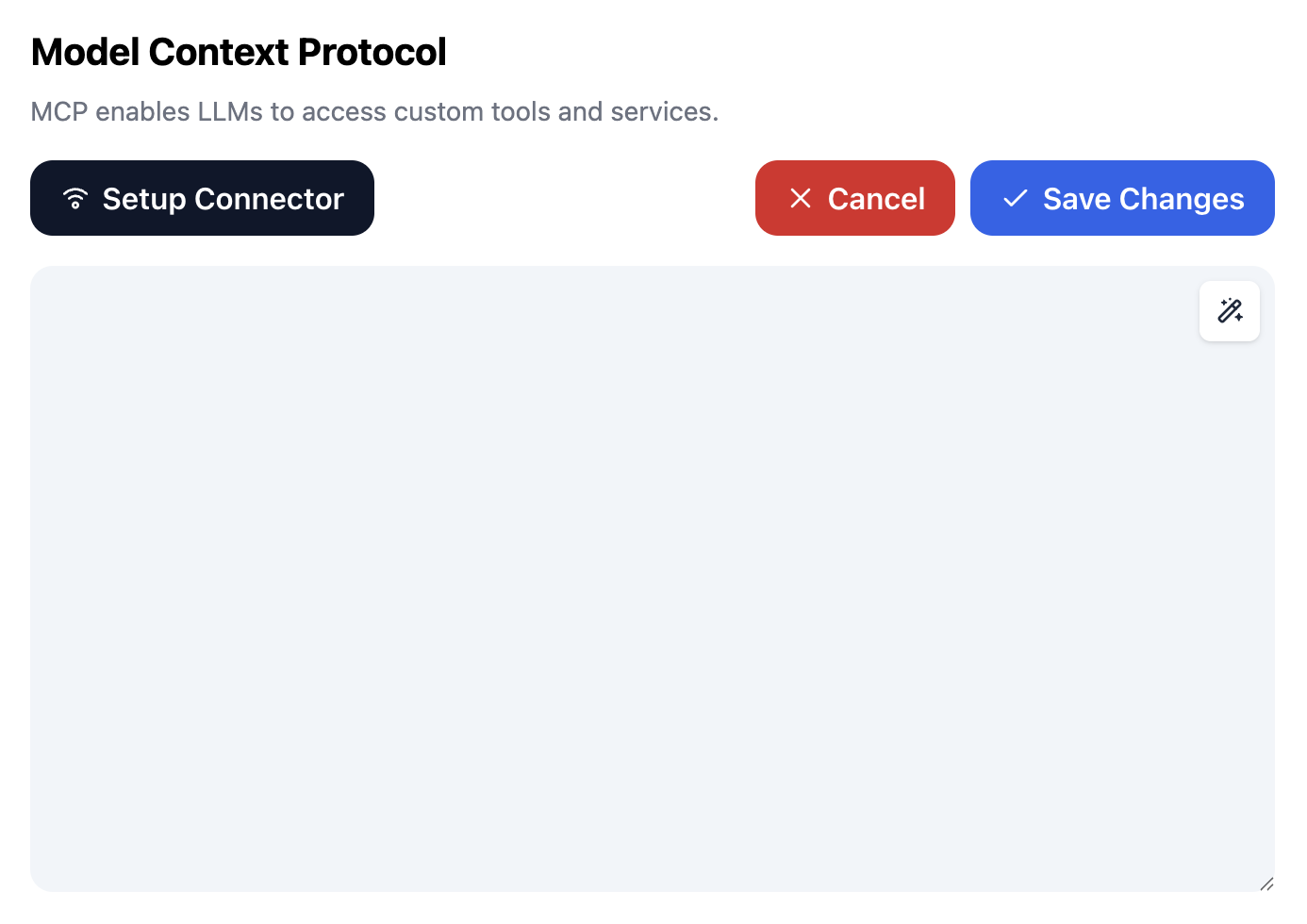
In TypingMind, go to Settings, Advanced Settings, then Model Context Protocol and choose Setup Connector.

  1. Open TypingMind in your browser.
  2. Click the Settings icon.
  3. Go to Advanced Settings.
  4. Open the Model Context Protocol section.
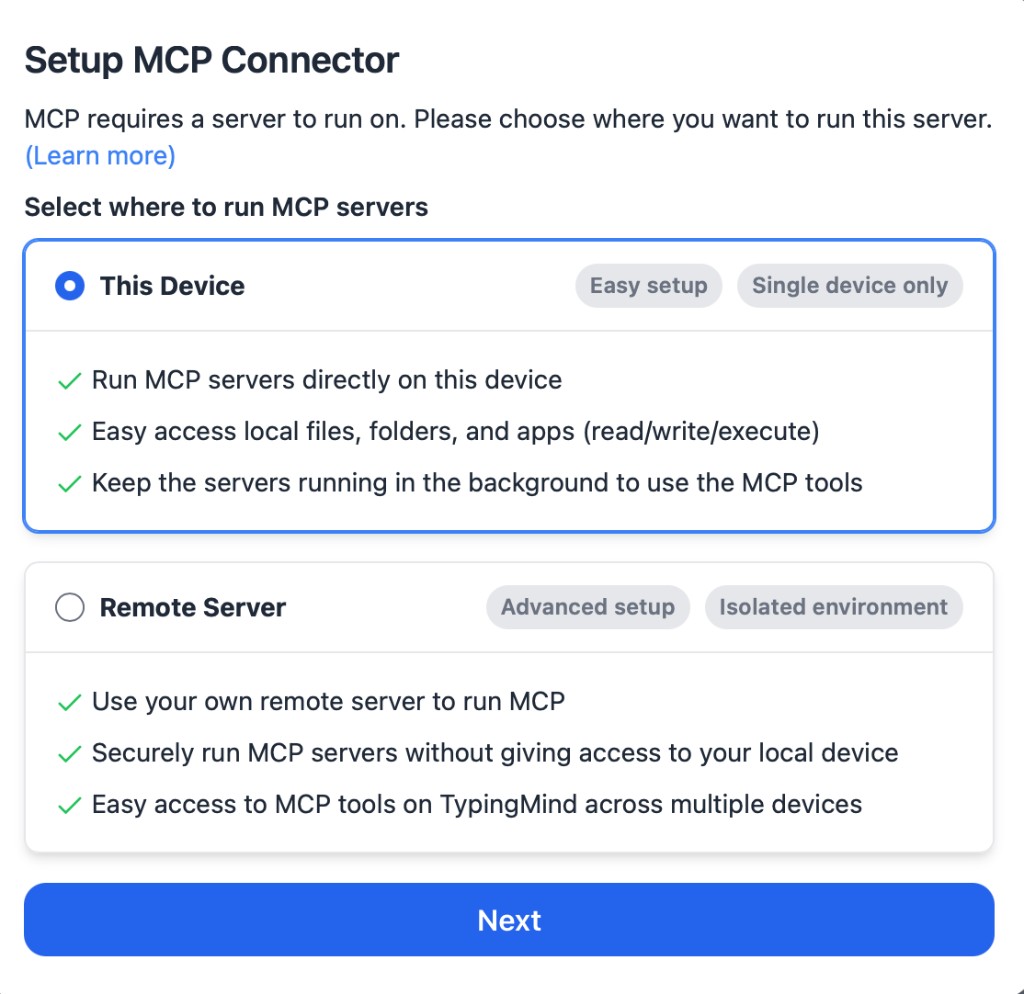
  5. Click Setup Connector and choose This Device.
TypingMind MCP connector setup screen with This Device selected
2

Run the connector command

Choose This Device, copy the command from TypingMind, and run it in Terminal. Keep the process running while you use MCP.

  1. Copy the setup command shown by TypingMind.
  2. Open Terminal on macOS or Windows Terminal on Windows.
  3. Paste and run the command.
  4. Approve the package install if Terminal asks you to proceed.
  5. Keep the Terminal window running while using MCP tools.
3

Add MCP Server Chart as a server

When the connector status is Ready, click Edit Servers and paste the MCP server configuration.

  1. Wait until the connector status shows Ready.
  2. Click Edit Servers.
  3. Paste the MCP Server Chart MCP server configuration.
  4. Save the server list.
  5. Refresh if you want to confirm the connector is still ready.
TypingMind MCP settings showing active server and Edit Servers button
{
  "mcpServers": {
    "mcp-server-chart": {
      "command": "npx",
      "args": [
        "-y",
        "@antv/mcp-server-chart"
      ]
    }
  }
}
4

Use it across models

Save the server list, open Plugins, enable the MCP Server Chart MCP tools, then select any supported AI model in TypingMind and use the tools in chat or assign them to an AI agent.

  1. Open the Plugins page in TypingMind.
  2. Enable the MCP Server Chart MCP tools.
  3. Start a chat and choose the AI model you want to use.
  4. Use the MCP tools in chat or assign them to an AI agent.
  5. Switch to another AI model whenever needed without reconnecting MCP.
TypingMind chat using enabled MCP tools with a selected AI model
Can you use MCP Server Chart to help me with this task?
MCP Server Chart
Sure. I read it.
Here is what I found using MCP Server Chart.

Option 2: Add an MCP server URL

Use this when MCP Server Chart is already hosted remotely or your team wants one shared connector that multiple users can access.

1

Open MCP connectors

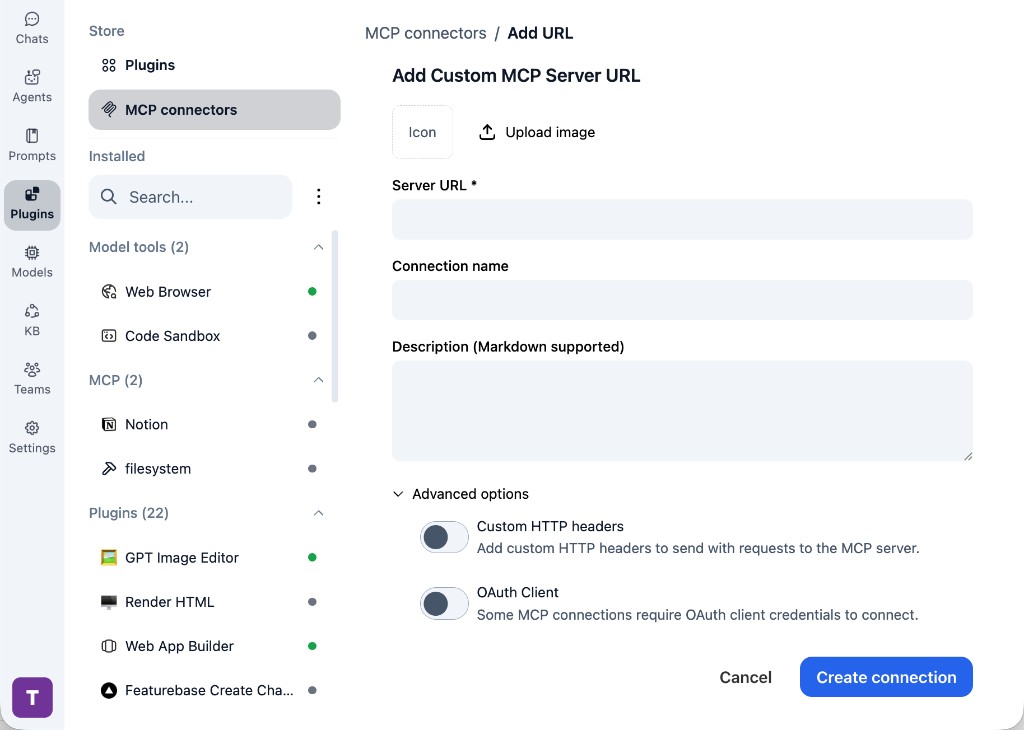
In TypingMind, go to Plugins, open MCP connectors, then choose Add URL.

  1. Open TypingMind in your browser.
  2. Go to Plugins.
  3. Open MCP connectors.
  4. Click Add URL.
TypingMind Add Custom MCP Server URL form
2

Paste the server URL

Enter your server URL in the Server URL field. Add a connection name, description, icon, custom HTTP headers, or OAuth client settings if the server requires them.

  1. Paste your server URL into the Server URL field.
  2. Enter a connection name for MCP Server Chart.
  3. Add a description and icon if you want it to be easier to identify.
  4. Add custom HTTP headers or OAuth client details if the server requires authentication.
3

Create the connection

Click Create connection, then return to the Plugins list and confirm the new MCP connection is active.

  1. Click Create connection.
  2. Return to the MCP connectors list.
  3. Confirm the MCP Server Chart connection appears as active.
  4. Refresh the plugin list if the connection does not appear immediately.
4

Switch models without reconnecting

Start a chat with your preferred model, enable the MCP Server Chart tools from Plugins, and switch to another model whenever needed. The MCP connection stays available to the TypingMind workspace.

  1. Start a new chat in TypingMind.
  2. Select the AI model you want to use.
  3. Enable the MCP Server Chart tools from Plugins.
  4. Ask the model to use the tool when needed.
  5. Switch to another AI model and reuse the same MCP connection.
TypingMind chat using enabled MCP tools with a selected AI model
Can you use MCP Server Chart to help me with this task?
MCP Server Chart
Sure. I read it.
Here is what I found using MCP Server Chart.

Frequently asked questions

What is the MCP Server Chart MCP server used for?

MCP Server Chart is an MCP server that lets compatible AI clients connect to external tools and context. In TypingMind, you can add this MCP server once and make its tools available in your AI workspace.

Can I use MCP Server Chart MCP with multiple AI models in TypingMind?

Yes. TypingMind connects MCP tools at the workspace level, so you can use MCP Server Chart with different AI models such as Claude, ChatGPT, Gemini, or other models you have configured in TypingMind without setting up the MCP server separately for each model.

Why use MCP Server Chart MCP with TypingMind?

TypingMind is one of the best frontends for LLM chat because it brings multiple AI models, prompts, plugins, AI agents, API keys, and MCP tools into one workspace. With MCP Server Chart connected, you can use its MCP tools across your preferred models while keeping your chat workflow organized in TypingMind.

How do I connect MCP Server Chart MCP to TypingMind?

MCP Server Chart can be connected in TypingMind with the local MCP connector or by adding a remote MCP server URL. Use the local connector when the server needs access to files, apps, or private resources on your device, and use a server URL when the MCP server is hosted remotely.

What tools does MCP Server Chart MCP provide in TypingMind?

MCP Server Chart exposes 26 MCP tools that can be enabled from the TypingMind Plugins page and used in chat or assigned to AI agents.

Do I need to share my API keys with TypingMind to use MCP Server Chart MCP?

No. TypingMind is local-first and lets you keep your model providers, API keys, prompts, and MCP configuration under your control. If MCP Server Chart requires authentication, add the required headers, OAuth settings, or local configuration for that MCP server when you create the connection.

Related MCP Servers

View all

Set up your own AI workspace now

Get notified about new features and future giveaways by subscribing to our newsletter 👇