Omnisearch logo

Omnisearch

Community
spences10

🔍 A Model Context Protocol (MCP) server providing unified access to multiple search engines (Tavily, Brave, Kagi, Exa), AI tools (Kagi FastGPT, Exa, Linkup), and content extraction services (Firecrawl, Tavily, Kagi). Includes GitHub search. All through a single interface.

Publisherspences10
Repositorymcp-omnisearch
LanguageTypeScript
Forks
47
Stars
305
Available tools
0
Transport typestdio
Categories
LicenseMIT
Links
  • Connect tools to AI workflows

    Omnisearch exposes MCP capabilities that can be used by compatible AI clients and agents.

  • 0 available tools

    Browse the callable actions below, including names and descriptions when provided by the server.

  • Ready-to-copy setup

    Use the installation snippets to configure this server in your preferred MCP client.

  • Open source signals

    305 stars and 47 forks from the linked repository.

mcp-omnisearch

built with vite+ tested with vitest

A Model Context Protocol (MCP) server that provides unified access to multiple search providers and AI tools. This server combines the capabilities of Tavily, Brave, Kagi, Exa AI, GitHub, Linkup, and Firecrawl to offer comprehensive search, AI responses, and content processing through four consolidated tools.

Features

🔍 web_search — Web Search

Search the web for information. Providers: tavily (factual/citations), brave (privacy/operators), kagi (quality/operators), exa (AI-semantic), kagi_enrichment (specialized indexes).

Parameters:

  • query (string, required): Search query
  • provider (string, required): tavily, brave, kagi, exa, or kagi_enrichment
  • limit (number, optional): Maximum number of results (default: 10)
  • include_domains (array, optional): Only return results from these domains
  • exclude_domains (array, optional): Exclude results from these domains
  • large_result_mode (string, optional): file or inline; overrides OMNISEARCH_LARGE_RESULT_MODE for this request

🤖 ai_search — AI-Powered Answers

Get AI-powered answers with citations and reasoning. Providers: kagi_fastgpt (fast ~900ms answers), exa_answer (semantic AI), linkup (deep agentic search with sources).

Parameters:

  • query (string, required): Question or search query
  • provider (string, required): kagi_fastgpt, exa_answer, or linkup
  • limit (number, optional): Maximum number of results (default: 10)
  • large_result_mode (string, optional): file or inline; overrides OMNISEARCH_LARGE_RESULT_MODE for this request

🔎 github_search — GitHub Search

Search GitHub for code, repositories, or users. Supports advanced syntax: filename:, path:, repo:, user:, language:, in:file.

Parameters:

  • query (string, required): Search query
  • search_type (string, optional): code, repositories, or users (default: code)
  • limit (number, optional): Maximum number of results (default: 10)
  • sort (string, optional): stars, forks, or updated (repositories only)

📄 web_extract — Content Extraction and Processing

Extract, process, or summarize web content from URLs. Providers: tavily (content extraction), kagi (summarization of pages/videos/podcasts), firecrawl (scraping/crawling/mapping/structured extraction/interactive), exa (content retrieval/similar pages).

Parameters:

  • url (string or array, required): URL or array of URLs to process
  • provider (string, required): tavily, kagi, firecrawl, or exa
  • mode (string, optional): Processing mode. Firecrawl: scrape/crawl/map/extract/actions. Exa: contents/similar. Tavily: extract. Kagi: summarize. Defaults to provider default.
  • extract_depth (string, optional): basic or advanced (default: basic)
  • large_result_mode (string, optional): file or inline; overrides OMNISEARCH_LARGE_RESULT_MODE for this request
  • include_raw_contents (boolean, optional): Set to false to omit duplicate per-URL raw text from extraction responses

🎯 Search Operators

MCP Omnisearch provides powerful search capabilities through operators and parameters:

Search Operator Reference

Brave & Kagi Operators (use in query string):

  • Domain: site:example.com, -site:example.com
  • File type: filetype:pdf or ext:pdf
  • Location: intitle:term, inurl:term, inbody:term, inpage:term
  • Language: lang:en (ISO 639-1 codes)
  • Country: loc:us (ISO 3166-1 codes)
  • Date: before:2024, after:2024-01-01
  • Exact: "exact phrase"
  • Include/Exclude: +required, -excluded

Tavily (translated to Tavily API parameters where supported):

  • Domain filtering: site: and -site: become include_domains and exclude_domains; explicit domain arrays are also supported
  • Date filtering: after: and before: become start_date and end_date
  • Exact phrases: quoted phrases enable exact-match behavior
  • Country filtering: loc: becomes Tavily's country parameter

Unsupported provider-specific operators remain part of the sanitized query when possible rather than being flattened globally.

Example Usage

typescript
// Brave/Kagi: Advanced operators in query
{
  "query": "filetype:pdf lang:en site:microsoft.com +typescript -javascript",
  "provider": "brave"
}

// Brave: advanced discovery with native operator passthrough
{
  "query": "intitle:benchmark inurl:blog filetype:pdf lang:en before:2025-01-01 \"vector database\" -site:pinterest.com",
  "provider": "brave"
}

// Kagi: focused research across docs and exact phrases
{
  "query": "site:docs.svelte.dev OR site:svelte.dev \"remote functions\" after:2025-01-01",
  "provider": "kagi"
}

// Brave/Kagi: Search gists
{
  "query": "site:gist.github.com claude code settings",
  "provider": "brave"
}

// Tavily: API parameters for domain filtering
{
  "query": "typescript guide",
  "provider": "tavily",
  "include_domains": ["microsoft.com"]
}

Provider Capabilities

  • Brave Search: Full native operator support in query string
  • Kagi Search: Complete operator support in query string
  • Tavily Search: Domain/date/exact/country operator translation into Tavily API parameters; explicit include_domains and exclude_domains arrays are supported
  • Exa Search: Domain filtering through API parameters, semantic search with neural understanding
  • GitHub Search: Advanced code search syntax with qualifiers:
    • filename:remote.ts - Search for specific files
    • path:src/lib - Search within specific directories
    • repo:user/repo - Search within specific repositories
    • user:username - Search within a user's repositories
    • language:typescript - Filter by programming language
    • in:file "export function" - Search for text within files

Flexible API Key Requirements

MCP Omnisearch is designed to work with the API keys you have available. You don't need to have keys for all providers - the server will automatically detect which API keys are available and only enable those providers.

For example:

  • If you only have a Tavily and Brave API key, only those providers will be available
  • If you don't have a Kagi API key, Kagi-based services won't be available, but all other providers will work normally
  • The server will log which providers are available based on the API keys you've configured

This flexibility makes it easy to get started with just one or two providers and add more as needed.

Configuration

This server requires configuration through your MCP client. Here are examples for different environments:

Cline Configuration

Add this to your Cline MCP settings:

json
{
	"mcpServers": {
		"mcp-omnisearch": {
			"command": "node",
			"args": ["/path/to/mcp-omnisearch/dist/index.js"],
			"env": {
				"TAVILY_API_KEY": "your-tavily-key",
				"KAGI_API_KEY": "your-kagi-key",
				"BRAVE_API_KEY": "your-brave-key",
				"GITHUB_API_KEY": "your-github-key",
				"EXA_API_KEY": "your-exa-key",
				"LINKUP_API_KEY": "your-linkup-key",
				"FIRECRAWL_API_KEY": "your-firecrawl-key",
				"FIRECRAWL_BASE_URL": "http://localhost:3002"
			},
			"disabled": false,
			"autoApprove": []
		}
	}
}

Claude Desktop with WSL Configuration

For WSL environments, add this to your Claude Desktop configuration:

json
{
	"mcpServers": {
		"mcp-omnisearch": {
			"command": "wsl.exe",
			"args": [
				"bash",
				"-c",
				"TAVILY_API_KEY=key1 KAGI_API_KEY=key2 BRAVE_API_KEY=key3 GITHUB_API_KEY=key4 EXA_API_KEY=key5 LINKUP_API_KEY=key6 FIRECRAWL_API_KEY=key7 FIRECRAWL_BASE_URL=http://localhost:3002 node /path/to/mcp-omnisearch/dist/index.js"
			]
		}
	}
}

Environment Variables

The server uses API keys for each provider. You don't need keys for all providers - only the providers corresponding to your available API keys will be activated:

  • TAVILY_API_KEY: For Tavily Search and content extraction
  • KAGI_API_KEY: For Kagi services (Search, FastGPT, Summarizer, Enrichment)
  • BRAVE_API_KEY: For Brave Search
  • GITHUB_API_KEY: For GitHub search services (Code, Repository, User search)
  • EXA_API_KEY: For Exa AI services (Search, Answer, Contents, Similar)
  • LINKUP_API_KEY: For Linkup AI search with sourced answers
  • FIRECRAWL_API_KEY: For Firecrawl services (Scrape, Crawl, Map, Extract, Actions)
  • FIRECRAWL_BASE_URL: For self-hosted Firecrawl instances (optional, defaults to Firecrawl cloud service)
  • OMNISEARCH_LARGE_RESULT_MODE: Controls oversized MCP responses: file (default) writes temp-file pointers, inline returns full content so MCP clients can handle indexing, truncation, or offload themselves.

You can start with just one or two API keys and add more later as needed. The server will log which providers are available on startup.

Large Result Behavior

Large search and extraction responses can exceed MCP client or transport limits. Each tool accepts large_result_mode to override the global OMNISEARCH_LARGE_RESULT_MODE setting for one request:

  • file (default): oversized responses are written to a server-side temp file and the tool returns a path, section list, line count, and read hint. This is compact for local stdio clients that share a filesystem with the server.
  • inline: the full response is returned through MCP. Use this for remote transports, clients with their own indexing/offload layer, or hosts like Pi that can capture large tool output.

For web_extract, set include_raw_contents: false when you only need the combined content field. This avoids duplicating huge per-URL text in both content and raw_contents.

Remote transport caveat: server-side temp-file paths are only useful when the MCP client can read the server's filesystem. Prefer inline for HTTP, hosted, containerized, or otherwise remote MCP deployments.

GitHub API Key Setup

To use GitHub search features, you'll need a GitHub personal access token with public repository access only for security:

  1. Go to GitHub Settings: Navigate to GitHub Settings > Developer settings > Personal access tokens

  2. Create a new token: Click "Generate new token" → "Generate new token (classic)"

  3. Configure token settings:

    • Name: MCP Omnisearch - Public Search

    • Expiration: Choose your preferred expiration (90 days recommended)

    • Scopes: Leave all checkboxes UNCHECKED

      ⚠️ Important: Do not select any scopes. An empty scope token can only access public repositories and user profiles, which is exactly what we want for search functionality.

  4. Generate and copy: Click "Generate token" and copy the token immediately

  5. Add to environment: Set GITHUB_API_KEY=your_token_here

Security Notes:

  • This token configuration ensures no access to private repositories
  • Only public code search, repository discovery, and user profiles are accessible
  • Rate limits: 5,000 requests/hour for code search, 10 requests/minute for code search specifically
  • You can revoke the token anytime from GitHub settings if needed

Self-Hosted Firecrawl Configuration

If you're running a self-hosted instance of Firecrawl, you can configure MCP Omnisearch to use it by setting the FIRECRAWL_BASE_URL environment variable. This allows you to maintain complete control over your data processing pipeline.

Self-hosted Firecrawl setup:

  1. Follow the Firecrawl self-hosting guide
  2. Set up your Firecrawl instance (default runs on http://localhost:3002)
  3. Configure MCP Omnisearch with your self-hosted URL:
bash
FIRECRAWL_BASE_URL=http://localhost:3002
# or for a remote self-hosted instance:
FIRECRAWL_BASE_URL=https://your-firecrawl-domain.com

Important notes:

  • If FIRECRAWL_BASE_URL is not set, MCP Omnisearch will default to the Firecrawl cloud service
  • Self-hosted instances support the same API endpoints (/v1/scrape, /v1/crawl, etc.)
  • You'll still need a FIRECRAWL_API_KEY even for self-hosted instances
  • Self-hosted Firecrawl provides enhanced security and customization options

API

The server exposes 4 consolidated MCP tools. Each tool dispatches to the provider you select:

web_search

Search the web for information.

json
{
	"query": "latest developments in quantum computing",
	"provider": "tavily"
}
json
{
	"query": "rust programming language features site:github.com",
	"provider": "brave",
	"limit": 15
}
json
{
	"query": "latest AI research papers",
	"provider": "exa",
	"include_domains": ["arxiv.org", "scholar.google.com"]
}

ai_search

Get AI-powered answers with citations.

json
{
	"query": "Explain the differences between REST and GraphQL",
	"provider": "kagi_fastgpt"
}
json
{
	"query": "How does machine learning work?",
	"provider": "exa_answer"
}
json
{
	"query": "What are the latest advances in quantum computing?",
	"provider": "linkup"
}

github_search

Search GitHub for code, repositories, or users.

json
{
	"query": "filename:remote.ts @sveltejs/kit",
	"search_type": "code",
	"limit": 5
}
json
{
	"query": "sveltekit remote functions",
	"search_type": "repositories",
	"sort": "stars"
}
json
{
	"query": "Rich-Harris",
	"search_type": "users",
	"limit": 3
}

web_extract

Extract, process, or summarize web content from URLs.

json
{
	"url": "https://example.com/long-article",
	"provider": "kagi",
	"mode": "summarize"
}
json
{
	"url": [
		"https://example.com/article1",
		"https://example.com/article2"
	],
	"provider": "tavily"
}
json
{
	"url": "https://example.com",
	"provider": "firecrawl",
	"mode": "crawl",
	"extract_depth": "advanced"
}
json
{
	"url": "https://arxiv.org/abs/2106.09685",
	"provider": "exa",
	"mode": "similar"
}

Docker Deployment

MCP Omnisearch supports containerized deployment using Docker with MCPO (Model Context Protocol Over HTTP) integration, enabling cloud deployment and OpenAPI access.

Quick Start with Docker

  1. Using Docker Compose (Recommended):
bash
# Clone the repository
git clone https://github.com/spences10/mcp-omnisearch.git
cd mcp-omnisearch

# Create .env file with your API keys
echo "TAVILY_API_KEY=your-tavily-key" > .env
echo "KAGI_API_KEY=your-kagi-key" >> .env
echo "BRAVE_API_KEY=your-brave-key" >> .env
echo "EXA_API_KEY=your-exa-key" >> .env
echo "GITHUB_API_KEY=your-github-key" >> .env
# Add other API keys as needed
echo "LINKUP_API_KEY=your-linkup-key" >> .env

# Start the container
docker-compose up -d
  1. Using Docker directly:
bash
docker build -t mcp-omnisearch .
docker run -d \
  -p 8000:8000 \
  -e TAVILY_API_KEY=your-tavily-key \
  -e KAGI_API_KEY=your-kagi-key \
  -e BRAVE_API_KEY=your-brave-key \
  -e EXA_API_KEY=your-exa-key \
  -e GITHUB_API_KEY=your-github-key \
  -e LINKUP_API_KEY=your-linkup-key \
  --name mcp-omnisearch \
  mcp-omnisearch

Container Environment Variables

Configure the container using environment variables for each provider:

  • TAVILY_API_KEY: For Tavily Search and content extraction
  • KAGI_API_KEY: For Kagi services (Search, FastGPT, Summarizer, Enrichment)
  • BRAVE_API_KEY: For Brave Search
  • GITHUB_API_KEY: For GitHub search services
  • EXA_API_KEY: For Exa AI services
  • LINKUP_API_KEY: For Linkup AI search
  • FIRECRAWL_API_KEY: For Firecrawl services
  • FIRECRAWL_BASE_URL: For self-hosted Firecrawl instances (optional)
  • PORT: Container port (defaults to 8000)

OpenAPI Access

Once deployed, the MCP server is accessible via OpenAPI at:

  • Base URL: http://your-container-host:8000
  • OpenAPI Endpoint: /omnisearch
  • Compatible with: OpenWebUI and other tools expecting OpenAPI

Cloud Deployment

The containerized version can be deployed to any container platform that supports Docker:

  • Cloud Run (Google Cloud)
  • Container Instances (Azure)
  • ECS/Fargate (AWS)
  • Railway, Render, Fly.io
  • Any Kubernetes cluster

Example deployment to a cloud platform:

bash
# Build and tag for your registry
docker build -t your-registry/mcp-omnisearch:latest .
docker push your-registry/mcp-omnisearch:latest

# Deploy with your platform's CLI or web interface
# Configure environment variables through your platform's settings

Development

Setup

  1. Clone the repository
  2. Install dependencies:
bash
pnpm install
  1. Build the project:
bash
pnpm run build
  1. Run in development mode:
bash
pnpm run dev

Publishing

  1. Update version in package.json
  2. Build the project:
bash
pnpm run build
  1. Publish to npm:
bash
pnpm publish

Troubleshooting

API Keys and Access

Each provider requires its own API key and may have different access requirements:

  • Tavily: Requires an API key from their developer portal
  • Kagi: Some features limited to Business (Team) plan users
  • Brave: API key from their developer portal
  • GitHub: Personal access token with no scopes selected (public access only)
  • Exa AI: API key from their dashboard at dashboard.exa.ai
  • Linkup: API key from their developer portal
  • Firecrawl: API key required from their developer portal

Common failure modes:

  • Missing API key: the provider is not registered; other configured providers continue working. Check omnisearch://providers/status for secret-safe availability details.
  • Invalid or unauthorized key: the request fails without exposing the key value. Verify the key belongs to the provider and has access to the endpoint or plan tier.
  • Invalid query/input: empty queries, unsupported modes, malformed domains, or unsupported URL protocols are rejected before calling the provider.
  • Rate limits and transient provider failures: 429, timeouts, network failures, and 5xx responses are retryable; invalid credentials and validation failures are not retried.
  • Remote MCP temp files: if a response returns a server-side file path that your client cannot read, retry with large_result_mode: "inline".

Rate Limits

Each provider has its own rate limits. The server will handle rate limit errors gracefully and return appropriate error messages.

Contributing

Please read CONTRIBUTING.md before opening a PR. In short:

  • Start by opening an issue to propose your change and align scope.
  • Prefer small, focused PRs with a clear explanation (problem → approach → verification).
  • Follow provider conventions: use src/common/http.ts (http_json) for HTTP, read keys from src/config/env.ts, respect timeouts, and surface errors via ProviderError.

License

MIT License - see the LICENSE file for details.

Acknowledgments

Built on:

Installation

TypingMind
Prerequisites:

Node.js 18+

{
  "mcpServers": {
    "mcp-omnisearch": {
      "command": "npx",
      "args": [
        "-y",
        "mcp-omnisearch"
      ],
      "env": {
        "TAVILY_API_KEY": "your-tavily-key",
        "PERPLEXITY_API_KEY": "your-perplexity-key",
        "KAGI_API_KEY": "your-kagi-key",
        "JINA_AI_API_KEY": "your-jina-key",
        "BRAVE_API_KEY": "your-brave-key",
        "GITHUB_API_KEY": "your-github-key",
        "EXA_API_KEY": "your-exa-key",
        "FIRECRAWL_API_KEY": "your-firecrawl-key",
        "FIRECRAWL_BASE_URL": "https://your-firecrawl-domain.com"
      }
    }
  }
}

Use Omnisearch MCP with multiple AI models

TypingMind connects MCP tools at the workspace level, so once Omnisearch is connected, you can use it with different AI models in TypingMind instead of setting it up separately for each model. This MCP runs locally through the TypingMind MCP connector on your device.

Setup guide to use the local connector

Use this when the MCP server needs access to local files, apps, or private resources on your computer.

1

Open the MCP settings

In TypingMind, go to Settings, Advanced Settings, then Model Context Protocol and choose Setup Connector.

  1. Open TypingMind in your browser.
  2. Click the Settings icon.
  3. Go to Advanced Settings.
  4. Open the Model Context Protocol section.
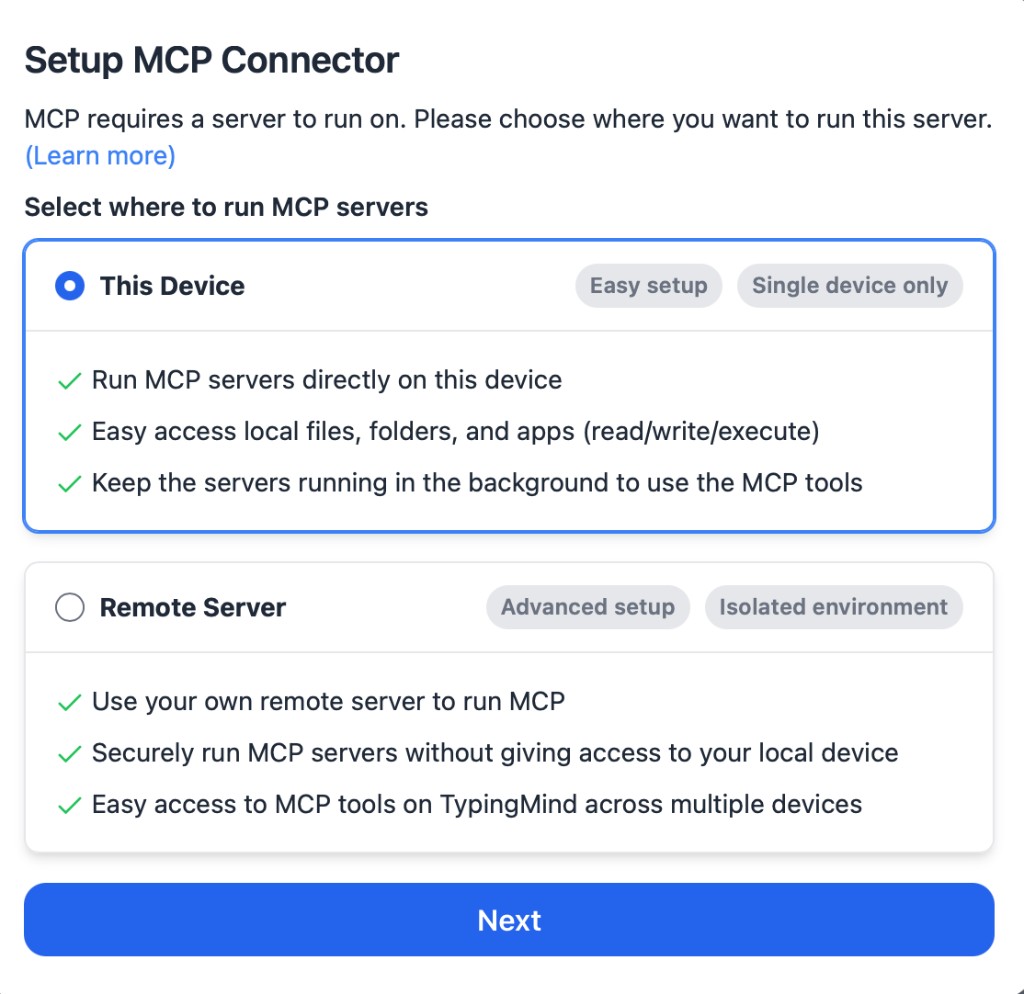
  5. Click Setup Connector and choose This Device.
TypingMind MCP connector setup screen with This Device selected
2

Run the connector command

Choose This Device, copy the command from TypingMind, and run it in Terminal. Keep the process running while you use MCP.

  1. Copy the setup command shown by TypingMind.
  2. Open Terminal on macOS or Windows Terminal on Windows.
  3. Paste and run the command.
  4. Approve the package install if Terminal asks you to proceed.
  5. Keep the Terminal window running while using MCP tools.
3

Add Omnisearch as a server

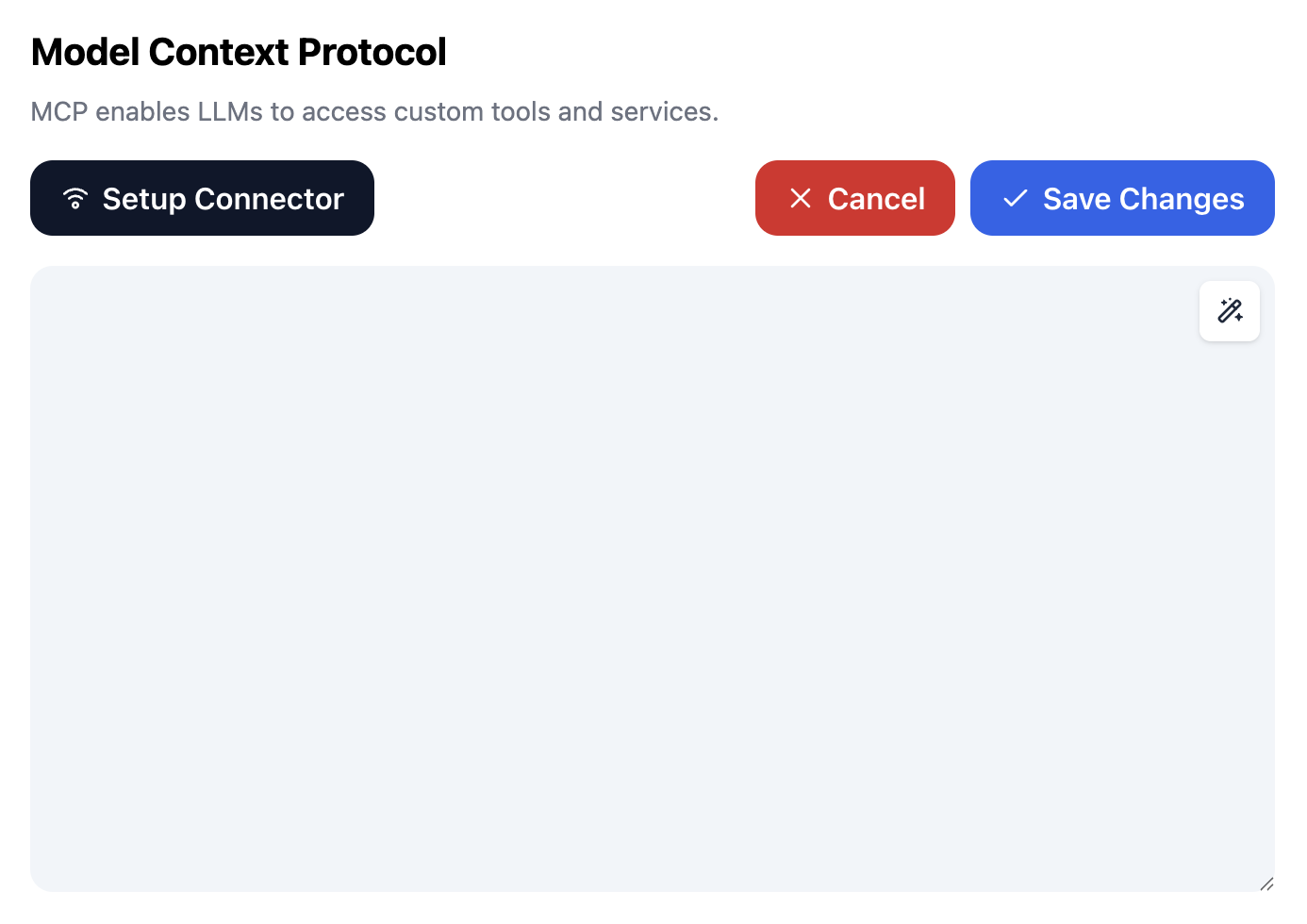
When the connector status is Ready, click Edit Servers and paste the MCP server configuration.

  1. Wait until the connector status shows Ready.
  2. Click Edit Servers.
  3. Paste the Omnisearch MCP server configuration.
  4. Save the server list.
  5. Refresh if you want to confirm the connector is still ready.
TypingMind MCP settings showing active server and Edit Servers button
{
  "mcpServers": {
    "omnisearch": {
      "command": "npx",
      "args": [
        "-y",
        "mcp-omnisearch"
      ]
    }
  }
}
4

Use it across models

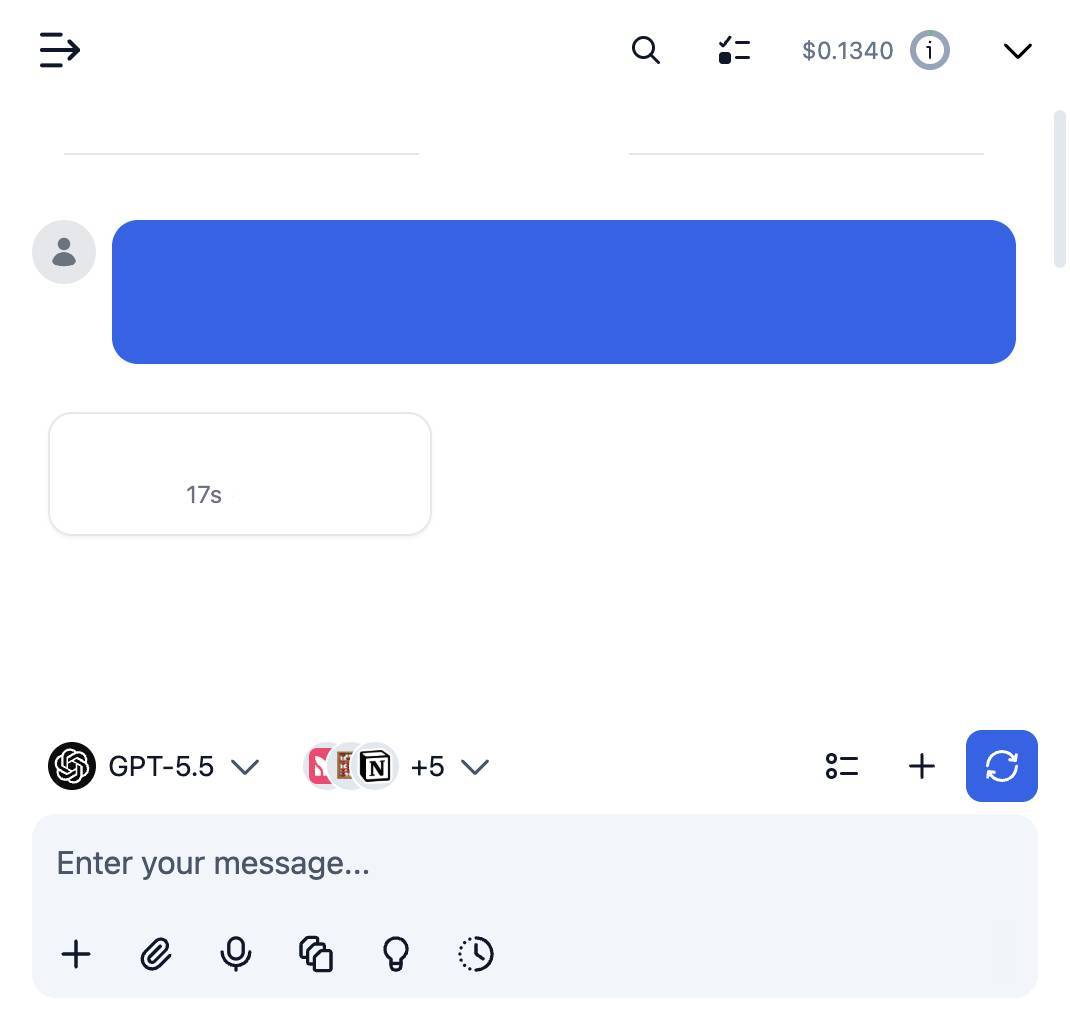
Save the server list, open Plugins, enable the Omnisearch MCP tools, then select any supported AI model in TypingMind and use the tools in chat or assign them to an AI agent.

  1. Open the Plugins page in TypingMind.
  2. Enable the Omnisearch MCP tools.
  3. Start a chat and choose the AI model you want to use.
  4. Use the MCP tools in chat or assign them to an AI agent.
  5. Switch to another AI model whenever needed without reconnecting MCP.
TypingMind chat using enabled MCP tools with a selected AI model
Can you use Omnisearch to help me with this task?
Omnisearch
Sure. I read it.
Here is what I found using Omnisearch.

Frequently asked questions

What is the Omnisearch MCP server used for?

Omnisearch is an MCP server that lets compatible AI clients connect to external tools and context. In TypingMind, you can add this MCP server once and make its tools available in your AI workspace.

Can I use Omnisearch MCP with multiple AI models in TypingMind?

Yes. TypingMind connects MCP tools at the workspace level, so you can use Omnisearch with different AI models such as Claude, ChatGPT, Gemini, or other models you have configured in TypingMind without setting up the MCP server separately for each model.

Why use Omnisearch MCP with TypingMind?

TypingMind is one of the best frontends for LLM chat because it brings multiple AI models, prompts, plugins, AI agents, API keys, and MCP tools into one workspace. With Omnisearch connected, you can use its MCP tools across your preferred models while keeping your chat workflow organized in TypingMind.

How do I connect Omnisearch MCP to TypingMind?

Omnisearch runs through the TypingMind local MCP connector. This is best when the MCP server needs access to local files, desktop apps, command-line tools, or private resources on your computer.

What tools does Omnisearch MCP provide in TypingMind?

Omnisearch exposes MCP capabilities that can be enabled from the TypingMind Plugins page and used in chat or assigned to AI agents.

Do I need to share my API keys with TypingMind to use Omnisearch MCP?

No. TypingMind is local-first and lets you keep your model providers, API keys, prompts, and MCP configuration under your control. If Omnisearch requires authentication, add the required headers, OAuth settings, or local configuration for that MCP server when you create the connection.

Related MCP Servers

View all

Set up your own AI workspace now

Get notified about new features and future giveaways by subscribing to our newsletter 👇