pgEdge PostgreSQL MCP Server logo

pgEdge PostgreSQL MCP Server

Organization
pgEdge

pgEdge MCP Server. A PostgreSQL MCP server with a Natural Language Agent CLI and Web UI.

PublisherpgEdge
Repositorypgedge-postgres-mcp
LanguageGo
Forks
22
Stars
228
Available tools
0
Transport typestdio
Categories
LicensePostgreSQL
Links
  • Connect tools to AI workflows

    pgEdge PostgreSQL MCP Server exposes MCP capabilities that can be used by compatible AI clients and agents.

  • 0 available tools

    Browse the callable actions below, including names and descriptions when provided by the server.

  • Ready-to-copy setup

    Use the installation snippets to configure this server in your preferred MCP client.

  • Open source signals

    228 stars and 22 forks from the linked repository.

pgEdge Postgres MCP Server and Natural Language Agent

CI - MCP Server CI - CLI Client CI - Web Client CI - Docker CI - Documentation

The pgEdge Postgres Model Context Protocol (MCP) server enables SQL queries against PostgreSQL databases through MCP-compatible clients. The Natural Language Agent provides supporting functionality that allows you to use natural language to form SQL queries.

Supported Versions: PostgreSQL 14 and higher.

NOT FOR PUBLIC-FACING APPLICATIONS: This MCP server provides LLMs with read access to your entire database schema and data. It should only be used for internal tools, developer workflows, or environments where all users are trusted. For public-facing applications, consider the pgEdge RAG Server instead. See the Choosing the Right Solution guide for details.

Quick Start

The Quick Start guide covers installation and setup for all supported clients:

ClientTransportBest For
CLI (Stdio)StdioLocal single-user development
CLI (HTTP)HTTPMulti-user or remote access
Web UIHTTPBrowser-based chat interface
Claude CodeStdioAnthropic CLI agent
Claude DesktopStdioAnthropic desktop app
CursorStdioAI code editor
WindsurfStdioCodeium code editor
VS Code CopilotStdioGitHub Copilot agent

For a guided demo with sample data, see the Quickstart Demo with Northwind.

Key Features

  • Read-Only Protection - All queries run in read-only transactions by default
  • Resources - Access PostgreSQL statistics and more
  • Tools - Query execution, schema analysis, advanced hybrid search (BM25+MMR), embedding generation, resource reading, and more
  • Prompts - Guided workflows for semantic search setup, database exploration, query diagnostics, and more
  • Production Chat Client - Full-featured Go client with Anthropic prompt caching (90% cost reduction)
  • HTTP/HTTPS Mode - Direct API access with user and token authentication
  • Web Interface - Modern React-based UI with AI-powered chat for natural language database interaction
  • Docker Support - Pre-built images on GitHub Container Registry with Docker Compose deployment
  • Secure - TLS support, user and token auth, read-only enforcement
  • Hot Reload - Automatic reload of authentication files without server restart

Development

Prerequisites

  • Go 1.21 or higher
  • PostgreSQL 14 or higher (for testing)
  • golangci-lint v1.x (for linting)

Setup Linter

The project uses golangci-lint v1.x. Install it with:

bash
go install github.com/golangci/golangci-lint/cmd/golangci-lint@latest

Note: The configuration file .golangci.yml is compatible with golangci-lint v1.x (not v2).

Building

bash
git clone https://github.com/pgEdge/pgedge-postgres-mcp.git
cd pgedge-postgres-mcp
make build

Testing

bash
# Run all tests
make test

# Run server tests with a database
export TEST_PGEDGE_POSTGRES_CONNECTION_STRING=\
  "postgres://localhost/postgres?sslmode=disable"
go test ./...

# Run with coverage
go test -v -cover ./...

# Run linting
make lint

Web UI Tests

The web UI has a comprehensive test suite. See web/TEST_SUMMARY.md for details.

bash
cd web
npm test                # Run all tests
npm run test:watch      # Watch mode
npm run test:coverage   # With coverage

Security

  • Read-only transaction enforcement (configurable per database)
  • User and API token authentication with expiration
  • TLS/HTTPS support
  • SHA256 token hashing
  • File permission enforcement (0600)
  • Input validation and sanitization

See the Security Guide for comprehensive security documentation.

Troubleshooting

Tools not visible in Claude Desktop?

  • Use absolute paths in config
  • Restart Claude Desktop completely
  • Check JSON syntax

Database connection errors?

  • Ensure database connection is configured before starting the server (via config file, environment variables, or command-line flags)
  • Verify PostgreSQL is running: pg_isready
  • Check connection parameters are correct

See the Troubleshooting Guide for detailed solutions.

Support

To report an issue with the software, visit: GitHub Issues

For more information, visit docs.pgedge.com

This project is licensed under the PostgreSQL License.
Use pgEdge PostgreSQL MCP Server MCP with multiple AI models

TypingMind connects MCP tools at the workspace level, so once pgEdge PostgreSQL MCP Server is connected, you can use it with different AI models in TypingMind instead of setting it up separately for each model. This MCP runs locally through the TypingMind MCP connector on your device.

Setup guide to use the local connector

Use this when the MCP server needs access to local files, apps, or private resources on your computer.

1

Open the MCP settings

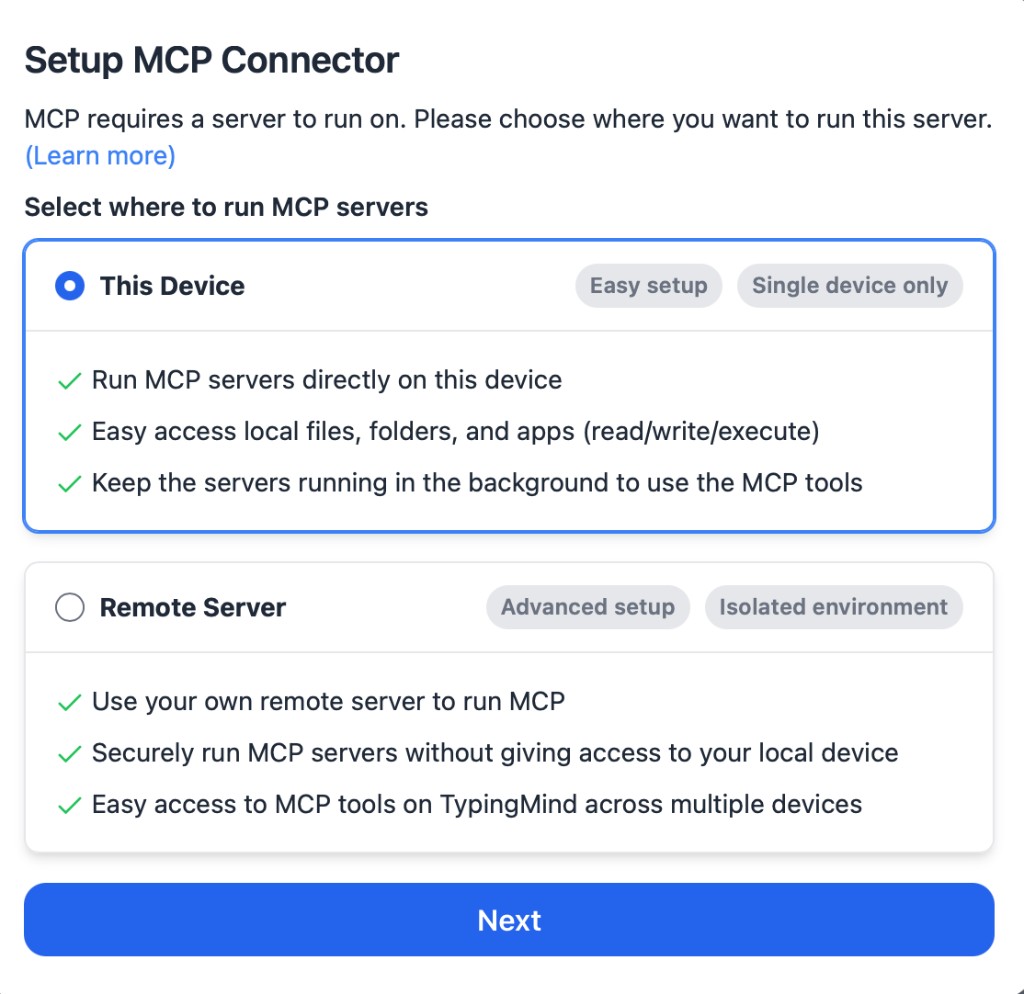
In TypingMind, go to Settings, Advanced Settings, then Model Context Protocol and choose Setup Connector.

  1. Open TypingMind in your browser.
  2. Click the Settings icon.
  3. Go to Advanced Settings.
  4. Open the Model Context Protocol section.
  5. Click Setup Connector and choose This Device.
TypingMind MCP connector setup screen with This Device selected
2

Run the connector command

Choose This Device, copy the command from TypingMind, and run it in Terminal. Keep the process running while you use MCP.

  1. Copy the setup command shown by TypingMind.
  2. Open Terminal on macOS or Windows Terminal on Windows.
  3. Paste and run the command.
  4. Approve the package install if Terminal asks you to proceed.
  5. Keep the Terminal window running while using MCP tools.
3

Add pgEdge PostgreSQL MCP Server as a server

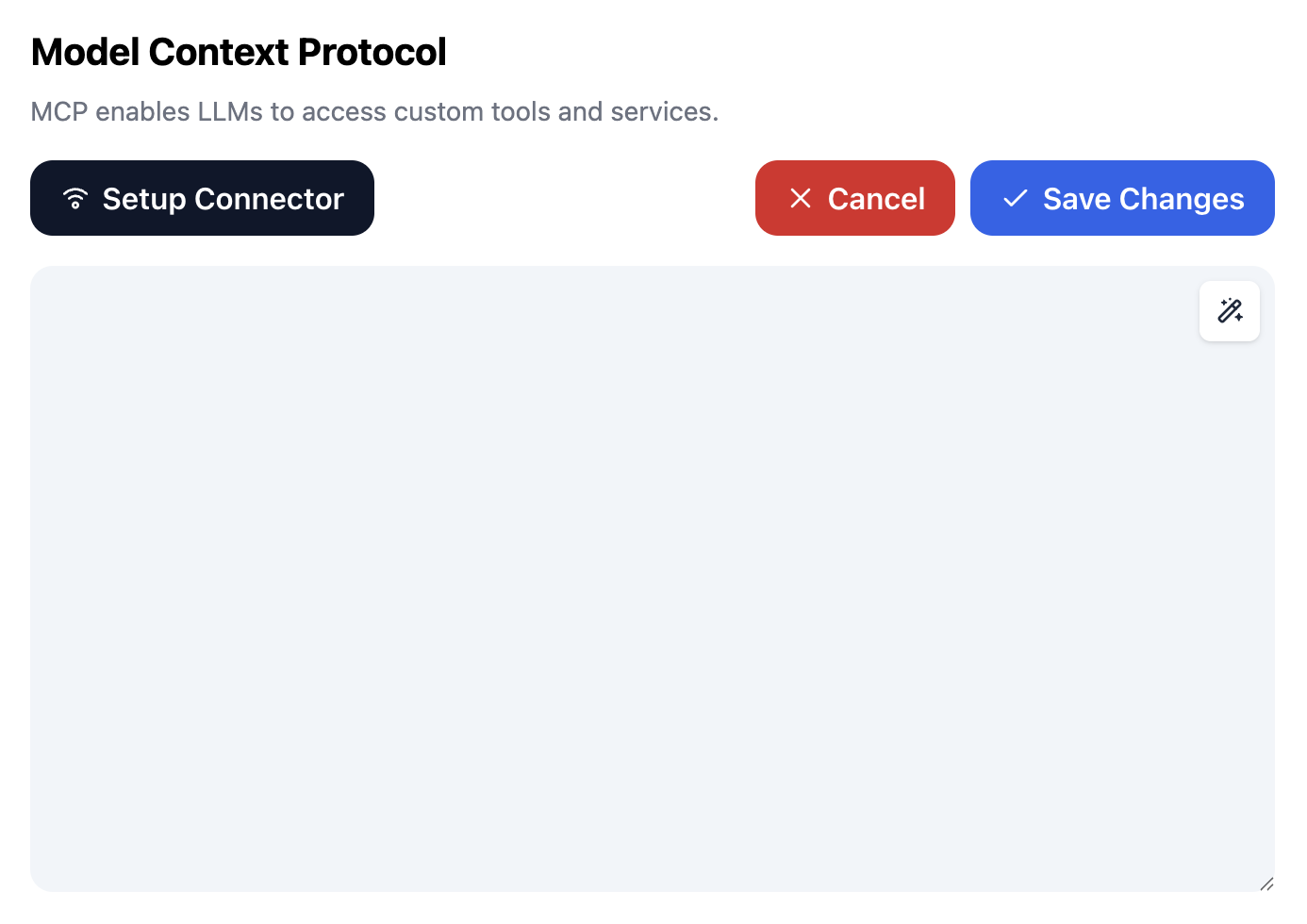
When the connector status is Ready, click Edit Servers and paste the MCP server configuration.

  1. Wait until the connector status shows Ready.
  2. Click Edit Servers.
  3. Paste the pgEdge PostgreSQL MCP Server MCP server configuration.
  4. Save the server list.
  5. Refresh if you want to confirm the connector is still ready.
TypingMind MCP settings showing active server and Edit Servers button
{
  "mcpServers": {
    "pgedge-postgres-mcp": {
      "command": "npx",
      "args": [
        "-y",
        "<mcp-server-package>"
      ]
    }
  }
}
4

Use it across models

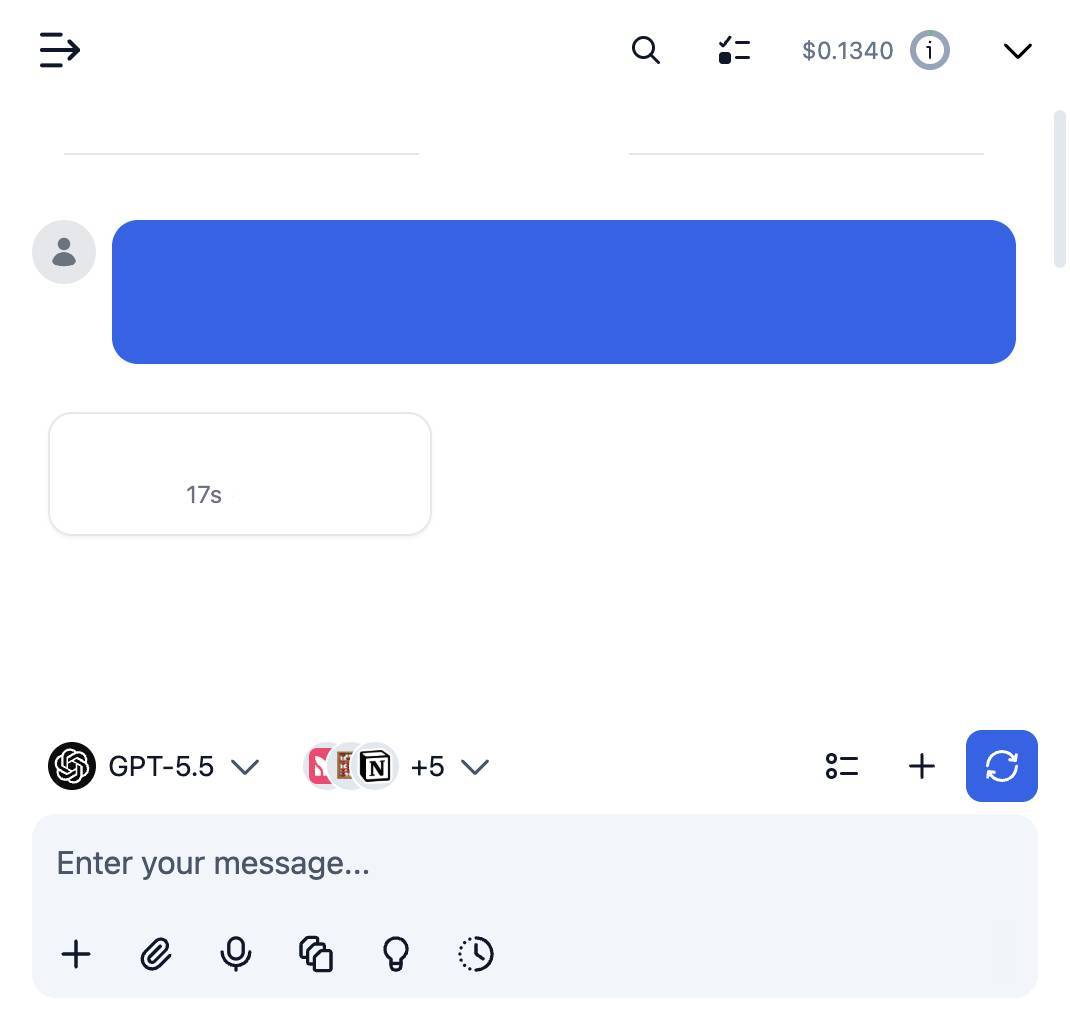
Save the server list, open Plugins, enable the pgEdge PostgreSQL MCP Server MCP tools, then select any supported AI model in TypingMind and use the tools in chat or assign them to an AI agent.

  1. Open the Plugins page in TypingMind.
  2. Enable the pgEdge PostgreSQL MCP Server MCP tools.
  3. Start a chat and choose the AI model you want to use.
  4. Use the MCP tools in chat or assign them to an AI agent.
  5. Switch to another AI model whenever needed without reconnecting MCP.
TypingMind chat using enabled MCP tools with a selected AI model
Can you use pgEdge PostgreSQL MCP Server to help me with this task?
pgEdge PostgreSQL MCP Server
Sure. I read it.
Here is what I found using pgEdge PostgreSQL MCP Server.

Frequently asked questions

What is the pgEdge PostgreSQL MCP Server MCP server used for?

pgEdge PostgreSQL MCP Server is an MCP server that lets compatible AI clients connect to external tools and context. In TypingMind, you can add this MCP server once and make its tools available in your AI workspace.

Can I use pgEdge PostgreSQL MCP Server MCP with multiple AI models in TypingMind?

Yes. TypingMind connects MCP tools at the workspace level, so you can use pgEdge PostgreSQL MCP Server with different AI models such as Claude, ChatGPT, Gemini, or other models you have configured in TypingMind without setting up the MCP server separately for each model.

Why use pgEdge PostgreSQL MCP Server MCP with TypingMind?

TypingMind is one of the best frontends for LLM chat because it brings multiple AI models, prompts, plugins, AI agents, API keys, and MCP tools into one workspace. With pgEdge PostgreSQL MCP Server connected, you can use its MCP tools across your preferred models while keeping your chat workflow organized in TypingMind.

How do I connect pgEdge PostgreSQL MCP Server MCP to TypingMind?

pgEdge PostgreSQL MCP Server runs through the TypingMind local MCP connector. This is best when the MCP server needs access to local files, desktop apps, command-line tools, or private resources on your computer.

What tools does pgEdge PostgreSQL MCP Server MCP provide in TypingMind?

pgEdge PostgreSQL MCP Server exposes MCP capabilities that can be enabled from the TypingMind Plugins page and used in chat or assigned to AI agents.

Do I need to share my API keys with TypingMind to use pgEdge PostgreSQL MCP Server MCP?

No. TypingMind is local-first and lets you keep your model providers, API keys, prompts, and MCP configuration under your control. If pgEdge PostgreSQL MCP Server requires authentication, add the required headers, OAuth settings, or local configuration for that MCP server when you create the connection.

Related MCP Servers

View all

Set up your own AI workspace now

Get notified about new features and future giveaways by subscribing to our newsletter 👇