Scrapling Fetch logo

Scrapling Fetch

Organization
cyberchitta

Helps AI assistants access text content from bot-protected websites. MCP server that fetches HTML/markdown from sites with anti-automation measures using Scrapling.

Publishercyberchitta
Repositoryscrapling-fetch-mcp
LanguagePython
Forks
17
Stars
84
Available tools
2
Transport typestdio
Categories
LicenseApache-2.0
Links
  • Connect tools to AI workflows

    Scrapling Fetch exposes MCP capabilities that can be used by compatible AI clients and agents.

  • 2 available tools

    Browse the callable actions below, including names and descriptions when provided by the server.

  • Ready-to-copy setup

    Use the installation snippets to configure this server in your preferred MCP client.

  • Open source signals

    84 stars and 17 forks from the linked repository.

scrapling-fetch-mcp

License PyPI version

Helps AI assistants fetch content from bot-protected websites. Uses Scrapling (patchright + curl-cffi) to bypass anti-automation measures, returning clean HTML or Markdown.

Optimized for low-volume retrieval of documentation and reference materials. Not designed for high-volume scraping or data harvesting.

Requirements: Python 3.10+, uv

Claude Code Skill

The easiest way to use this is as a Claude Code skill. Once installed, Claude will automatically fetch bot-protected URLs when you ask — no manual commands needed.

Install into your project (recommended — only loads in this project's context):

bash
git clone --depth=1 https://github.com/cyberchitta/scrapling-fetch-mcp /tmp/scrapling-fetch-mcp
cp -r /tmp/scrapling-fetch-mcp/skills/s-fetch .claude/skills/
rm -rf /tmp/scrapling-fetch-mcp

Or install for all projects (loads into context everywhere):

bash
git clone --depth=1 https://github.com/cyberchitta/scrapling-fetch-mcp /tmp/scrapling-fetch-mcp
cp -r /tmp/scrapling-fetch-mcp/skills/s-fetch ~/.claude/skills/
rm -rf /tmp/scrapling-fetch-mcp

The first time you invoke /s-fetch, Claude will read skills/s-fetch/references/install.md and run the one-time setup (installs the tool and downloads browser binaries). After that, just ask naturally:

"Fetch the docs at https://example.com/api"
"Find all mentions of 'authentication' on that page"
"Get me the installation instructions from their homepage"

Claude Desktop (MCP Server)

If the /s-fetch skill has already installed the tool, skip to the config below.

Otherwise install first:

bash
uv tool install git+https://github.com/cyberchitta/scrapling-fetch-mcp
uvx --from git+https://github.com/cyberchitta/scrapling-fetch-mcp scrapling install

Note: Browser installation downloads hundreds of MB and must complete before first use. If the server times out initially, wait a few minutes and try again.

Add this to your Claude Desktop MCP settings and restart:

MacOS: ~/Library/Application Support/Claude/claude_desktop_config.json
Windows: %APPDATA%\Claude\claude_desktop_config.json

json
{
  "mcpServers": {
    "scrapling-fetch": {
      "command": "uvx",
      "args": ["scrapling-fetch-mcp"]
    }
  }
}

How It Works

Two tools, used automatically by Claude:

  • Page fetching — retrieves complete pages with pagination support
  • Pattern extraction — finds content matching a regex

Three protection levels, escalated automatically:

  • basic — fast (1-2s), works for most sites
  • stealth — moderate (3-8s), headless Chromium
  • max-stealth — thorough (10s+), full browser fingerprint

Limitations

  • Text content only (documentation, articles, references)
  • Not for high-volume scraping or sites requiring authentication
  • Performance varies by site complexity and protection level

License

Apache 2.0
Installation

TypingMind
Prerequisites:

Node.js 18+

{
  "mcpServers": {
    "Cyber-Chitta": {
      "command": "uvx",
      "args": [
        "scrapling-fetch-mcp"
      ]
    }
  }
}

Available Tools

  • s_fetch_page

    Fetches a complete web page with pagination support. Retrieves content from websites with bot-detection avoidance. For best performance, start with 'basic' mode (fastest), then only escalate to 'stealth' or 'max-stealth' modes if basic mode fails. Content is returned as 'METADATA: {json}\n\n[content]' where metadata includes length information and truncation status.

    Args:
        url: URL to fetch
        mode: Fetching mode (basic, stealth, or max-stealth)
        format: Output format (html or markdown)
        max_length: Maximum number of characters to return.
        start_index: On return output starting at this character index, useful if a previous fetch was truncated and more content is required.
    
  • s_fetch_pattern

    Extracts content matching regex patterns from web pages. Retrieves specific content from websites with bot-detection avoidance. For best performance, start with 'basic' mode (fastest), then only escalate to 'stealth' or 'max-stealth' modes if basic mode fails. Returns matched content as 'METADATA: {json}\n\n[content]' where metadata includes match statistics and truncation information. Each matched content chunk is delimited with '॥๛॥' and prefixed with '[Position: start-end]' indicating its byte position in the original document, allowing targeted follow-up requests with s-fetch-page using specific start_index values.

    Args:
        url: URL to fetch
        search_pattern: Regular expression pattern to search for in the content
        mode: Fetching mode (basic, stealth, or max-stealth)
        format: Output format (html or markdown)
        max_length: Maximum number of characters to return.
        context_chars: Number of characters to include before and after each match
    

Use Scrapling Fetch MCP with multiple AI models

TypingMind connects MCP tools at the workspace level, so once Scrapling Fetch is connected, you can use it with different AI models in TypingMind instead of setting it up separately for each model. This MCP runs locally through the TypingMind MCP connector on your device.

Setup guide to use the local connector

Use this when the MCP server needs access to local files, apps, or private resources on your computer.

1

Open the MCP settings

In TypingMind, go to Settings, Advanced Settings, then Model Context Protocol and choose Setup Connector.

  1. Open TypingMind in your browser.
  2. Click the Settings icon.
  3. Go to Advanced Settings.
  4. Open the Model Context Protocol section.
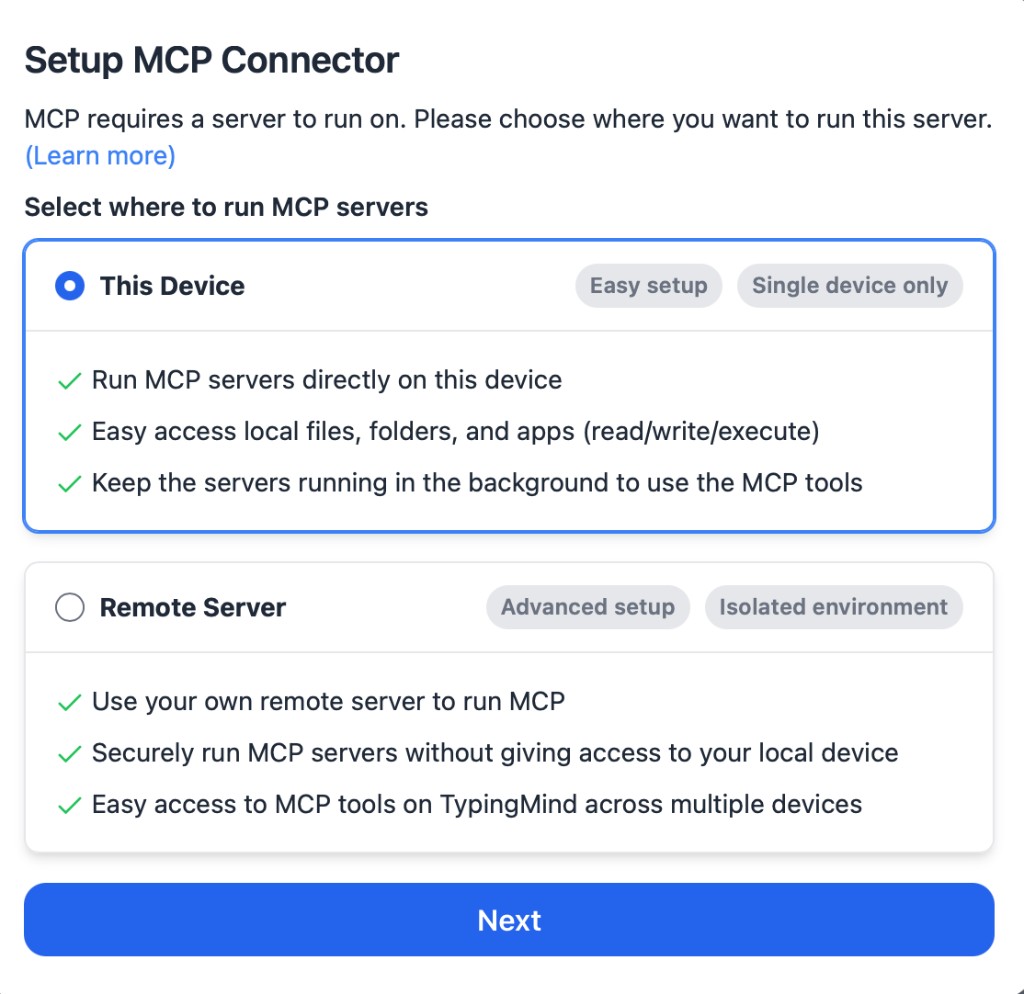
  5. Click Setup Connector and choose This Device.
TypingMind MCP connector setup screen with This Device selected
2

Run the connector command

Choose This Device, copy the command from TypingMind, and run it in Terminal. Keep the process running while you use MCP.

  1. Copy the setup command shown by TypingMind.
  2. Open Terminal on macOS or Windows Terminal on Windows.
  3. Paste and run the command.
  4. Approve the package install if Terminal asks you to proceed.
  5. Keep the Terminal window running while using MCP tools.
3

Add Scrapling Fetch as a server

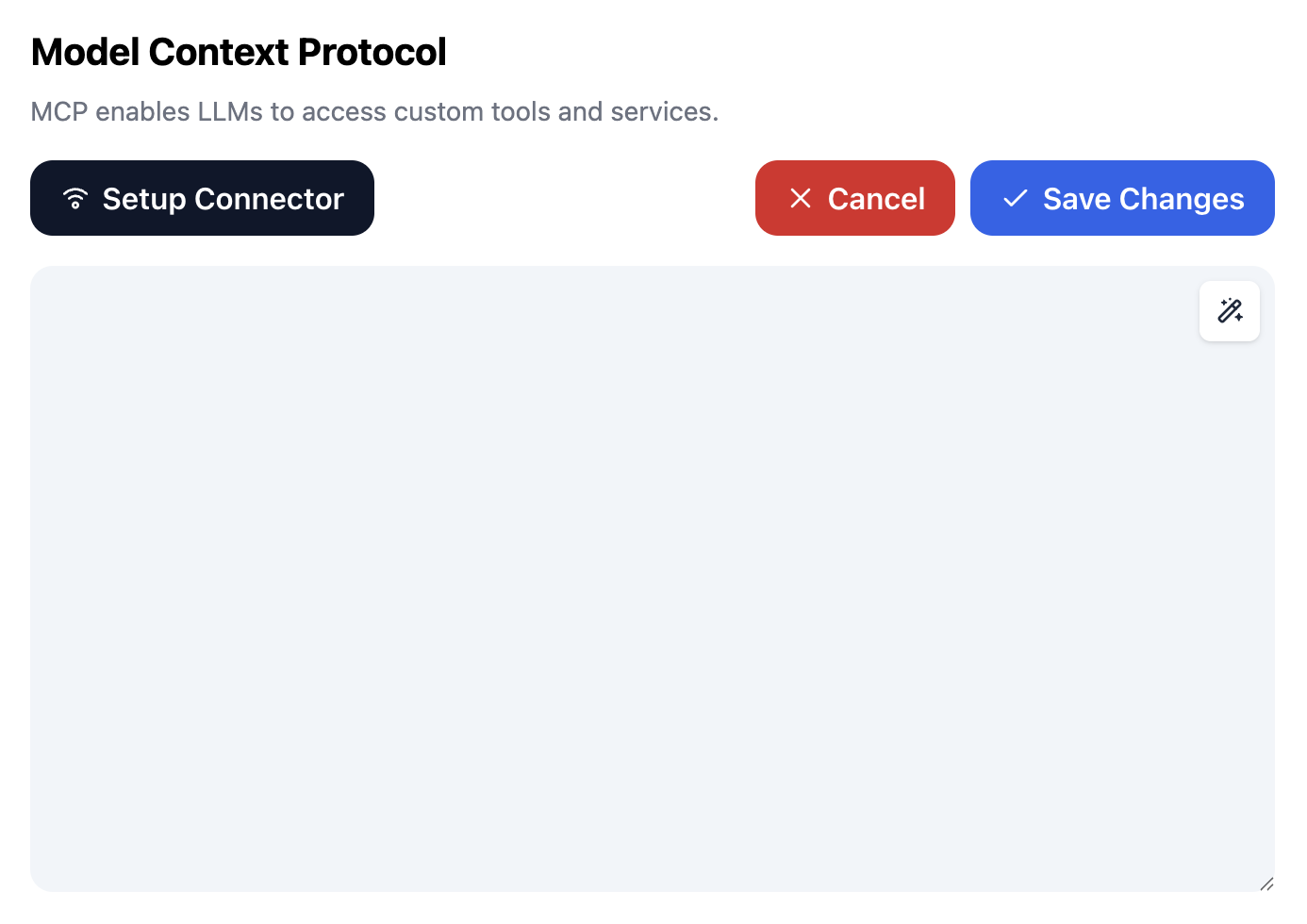
When the connector status is Ready, click Edit Servers and paste the MCP server configuration.

  1. Wait until the connector status shows Ready.
  2. Click Edit Servers.
  3. Paste the Scrapling Fetch MCP server configuration.
  4. Save the server list.
  5. Refresh if you want to confirm the connector is still ready.
TypingMind MCP settings showing active server and Edit Servers button
{
  "mcpServers": {
    "scrapling-fetch": {
      "command": "npx",
      "args": [
        "-y",
        "scrapling-fetch-mcp"
      ]
    }
  }
}
4

Use it across models

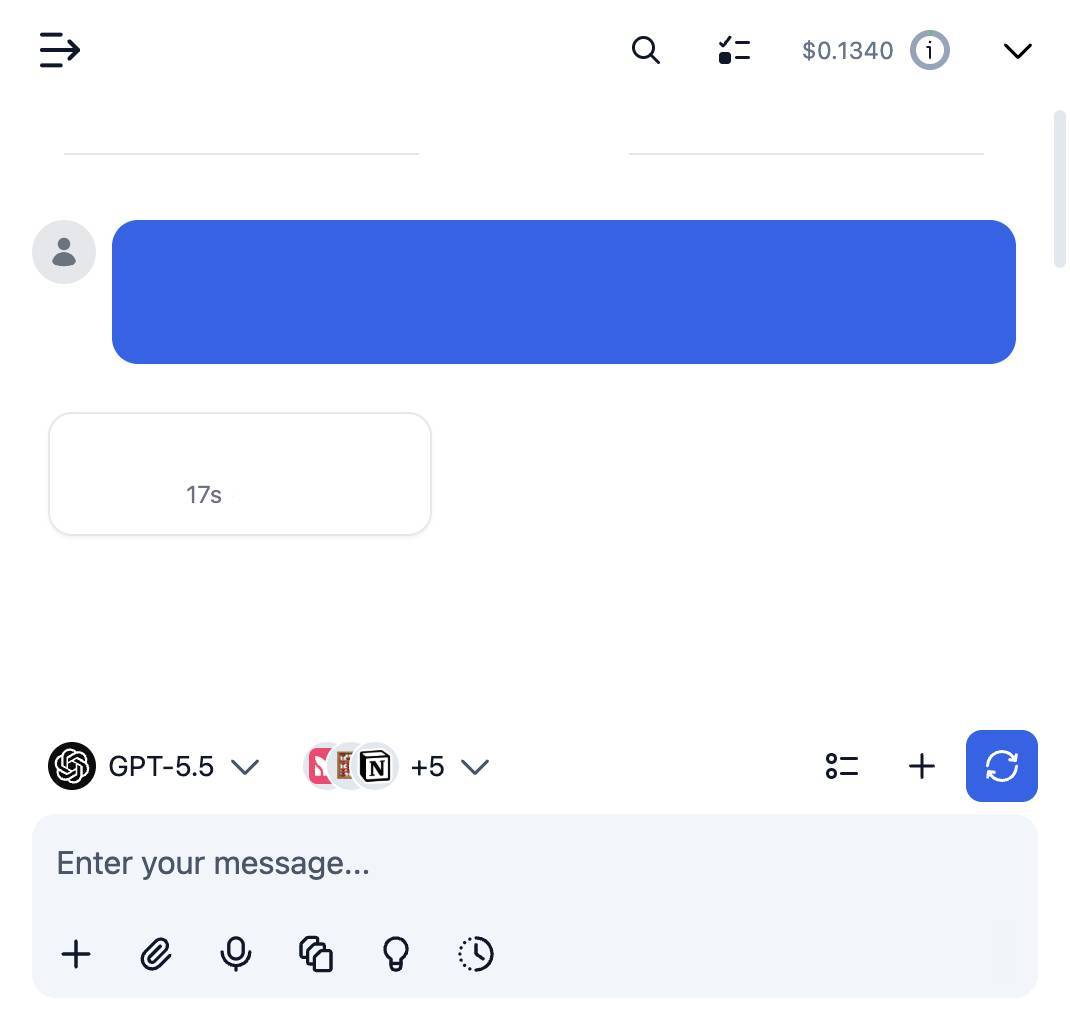
Save the server list, open Plugins, enable the Scrapling Fetch MCP tools, then select any supported AI model in TypingMind and use the tools in chat or assign them to an AI agent.

  1. Open the Plugins page in TypingMind.
  2. Enable the Scrapling Fetch MCP tools.
  3. Start a chat and choose the AI model you want to use.
  4. Use the MCP tools in chat or assign them to an AI agent.
  5. Switch to another AI model whenever needed without reconnecting MCP.
TypingMind chat using enabled MCP tools with a selected AI model
Can you use Scrapling Fetch to help me with this task?
Scrapling Fetch
Sure. I read it.
Here is what I found using Scrapling Fetch.

Frequently asked questions

What is the Scrapling Fetch MCP server used for?

Scrapling Fetch is an MCP server that lets compatible AI clients connect to external tools and context. In TypingMind, you can add this MCP server once and make its tools available in your AI workspace.

Can I use Scrapling Fetch MCP with multiple AI models in TypingMind?

Yes. TypingMind connects MCP tools at the workspace level, so you can use Scrapling Fetch with different AI models such as Claude, ChatGPT, Gemini, or other models you have configured in TypingMind without setting up the MCP server separately for each model.

Why use Scrapling Fetch MCP with TypingMind?

TypingMind is one of the best frontends for LLM chat because it brings multiple AI models, prompts, plugins, AI agents, API keys, and MCP tools into one workspace. With Scrapling Fetch connected, you can use its MCP tools across your preferred models while keeping your chat workflow organized in TypingMind.

How do I connect Scrapling Fetch MCP to TypingMind?

Scrapling Fetch runs through the TypingMind local MCP connector. This is best when the MCP server needs access to local files, desktop apps, command-line tools, or private resources on your computer.

What tools does Scrapling Fetch MCP provide in TypingMind?

Scrapling Fetch exposes 2 MCP tools that can be enabled from the TypingMind Plugins page and used in chat or assigned to AI agents.

Do I need to share my API keys with TypingMind to use Scrapling Fetch MCP?

No. TypingMind is local-first and lets you keep your model providers, API keys, prompts, and MCP configuration under your control. If Scrapling Fetch requires authentication, add the required headers, OAuth settings, or local configuration for that MCP server when you create the connection.

Related MCP Servers

View all

Set up your own AI workspace now

Get notified about new features and future giveaways by subscribing to our newsletter 👇