Voice MCP logo

Voice MCP

CommunityPopular
mbailey

Natural voice conversations with Claude Code

Publishermbailey
Repositoryvoicemode
LanguagePython
Forks
160
Stars
1.2K
Available tools
0
Transport typestdio
Categories
LicenseMIT
Links
  • Connect tools to AI workflows

    Voice MCP exposes MCP capabilities that can be used by compatible AI clients and agents.

  • 0 available tools

    Browse the callable actions below, including names and descriptions when provided by the server.

  • Ready-to-copy setup

    Use the installation snippets to configure this server in your preferred MCP client.

  • Open source signals

    1.2K stars and 160 forks from the linked repository.

VoiceMode

Natural voice conversations with Claude Code (and other MCP capable agents)

PyPI Downloads PyPI Downloads PyPI Downloads

VoiceMode enables natural voice conversations with Claude Code. Voice isn't about replacing typing - it's about being available when typing isn't.

Perfect for:

  • Walking to your next meeting
  • Cooking while debugging
  • Giving your eyes a break after hours of screen time
  • Holding a coffee (or a dog)
  • Any moment when your hands or eyes are busy

See It In Action

VoiceMode Demo

Quick Start

Requirements: Computer with microphone and speakers

Option 1: Claude Code Plugin (Recommended)

The fastest way for Claude Code users to get started:

bash
# Add the VoiceMode marketplace
claude plugin marketplace add mbailey/voicemode

# Install VoiceMode plugin
claude plugin install voicemode@voicemode

## Install dependencies (CLI, Local Voice Services)

/voicemode:install

# Start talking!
/voicemode:converse

Option 2: Python installer package

Installs dependencies and the VoiceMode Python package.

bash
# Install UV package manager (if needed)
curl -LsSf https://astral.sh/uv/install.sh | sh

# Run the installer (sets up dependencies and local voice services)
uvx voice-mode-install

# Add to Claude Code
claude mcp add --scope user voicemode -- uvx --refresh voice-mode

# Optional: Add OpenAI API key as fallback for local services
export OPENAI_API_KEY=your-openai-key

# Start a conversation
claude converse

For manual setup, see the Getting Started Guide.

Features

  • Natural conversations - speak naturally, hear responses immediately
  • Works offline - optional local voice services (Whisper STT, Kokoro TTS)
  • Low latency - fast enough to feel like a real conversation
  • Smart silence detection - stops recording when you stop speaking
  • Privacy options - run entirely locally or use cloud services

Compatibility

Platforms: Linux, macOS, Windows (WSL), NixOS Python: 3.10-3.14

Configuration

VoiceMode works out of the box. For customization:

bash
# Set OpenAI API key (if using cloud services)
export OPENAI_API_KEY="your-key"

# Or configure via file
voicemode config edit

See the Configuration Guide for all options.

Permissions Setup (Optional)

To use VoiceMode without permission prompts, add to ~/.claude/settings.json:

json
{
  "permissions": {
    "allow": [
      "mcp__voicemode__converse",
      "mcp__voicemode__service"
    ]
  }
}

See the Permissions Guide for more options.

Local Voice Services

For privacy or offline use, install local speech services:

  • Whisper.cpp - Local speech-to-text
  • Kokoro - Local text-to-speech with multiple voices

These provide the same API as OpenAI, so VoiceMode switches seamlessly between them.

Installation Details

Ubuntu/Debian

bash
sudo apt update
sudo apt install -y ffmpeg gcc libasound2-dev libasound2-plugins libportaudio2 portaudio19-dev pulseaudio pulseaudio-utils python3-dev

WSL2 users: The pulseaudio packages above are required for microphone access.

Fedora/RHEL

bash
sudo dnf install alsa-lib-devel ffmpeg gcc portaudio portaudio-devel python3-devel

macOS

bash
brew install ffmpeg node portaudio

NixOS

bash
# Use development shell
nix develop github:mbailey/voicemode

# Or install system-wide
nix profile install github:mbailey/voicemode

From source

bash
git clone https://github.com/mbailey/voicemode.git
cd voicemode
uv tool install -e .

NixOS system-wide

nix
# In /etc/nixos/configuration.nix
environment.systemPackages = [
  (builtins.getFlake "github:mbailey/voicemode").packages.${pkgs.system}.default
];

Troubleshooting

ProblemSolution
No microphone accessCheck terminal/app permissions. WSL2 needs pulseaudio packages.
UV not foundRun curl -LsSf https://astral.sh/uv/install.sh | sh
OpenAI API errorVerify OPENAI_API_KEY is set correctly
No audio outputCheck system audio settings and available devices

Save Audio for Debugging

bash
export VOICEMODE_SAVE_AUDIO=true
# Files saved to ~/.voicemode/audio/YYYY/MM/

Documentation

Full documentation: voice-mode.readthedocs.io

Links

License

MIT - A Failmode Project


mcp-name: com.failmode/voicemode

Installation

TypingMind
Prerequisites:

Node.js 18+

{
  "mcpServers": {
    "voice-mode": {
      "command": "uvx",
      "args": [
        "voice-mode"
      ],
      "env": {
        "OPENAI_API_KEY": "your-openai-key"
      }
    }
  }
}

Use Voice MCP MCP with multiple AI models

TypingMind connects MCP tools at the workspace level, so once Voice MCP is connected, you can use it with different AI models in TypingMind instead of setting it up separately for each model. This MCP runs locally through the TypingMind MCP connector on your device.

Setup guide to use the local connector

Use this when the MCP server needs access to local files, apps, or private resources on your computer.

1

Open the MCP settings

In TypingMind, go to Settings, Advanced Settings, then Model Context Protocol and choose Setup Connector.

  1. Open TypingMind in your browser.
  2. Click the Settings icon.
  3. Go to Advanced Settings.
  4. Open the Model Context Protocol section.
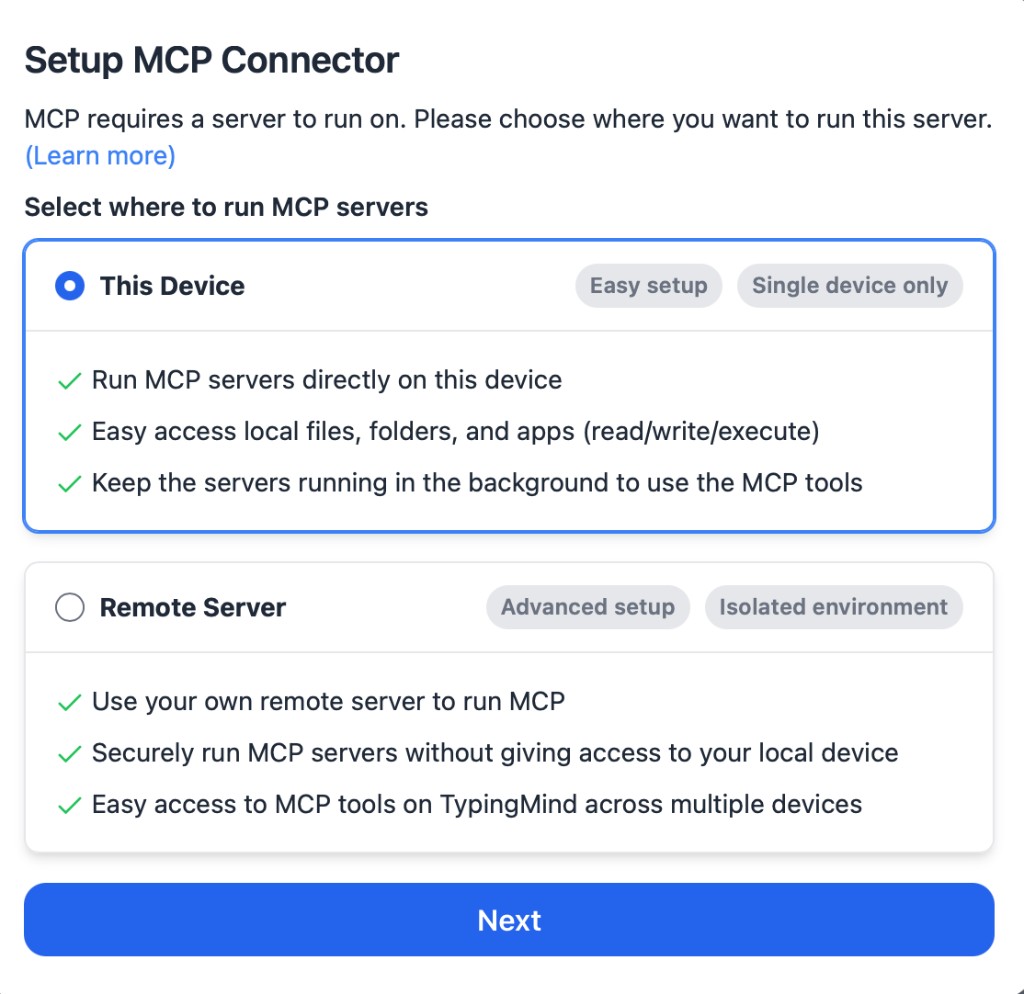
  5. Click Setup Connector and choose This Device.
TypingMind MCP connector setup screen with This Device selected
2

Run the connector command

Choose This Device, copy the command from TypingMind, and run it in Terminal. Keep the process running while you use MCP.

  1. Copy the setup command shown by TypingMind.
  2. Open Terminal on macOS or Windows Terminal on Windows.
  3. Paste and run the command.
  4. Approve the package install if Terminal asks you to proceed.
  5. Keep the Terminal window running while using MCP tools.
3

Add Voice MCP as a server

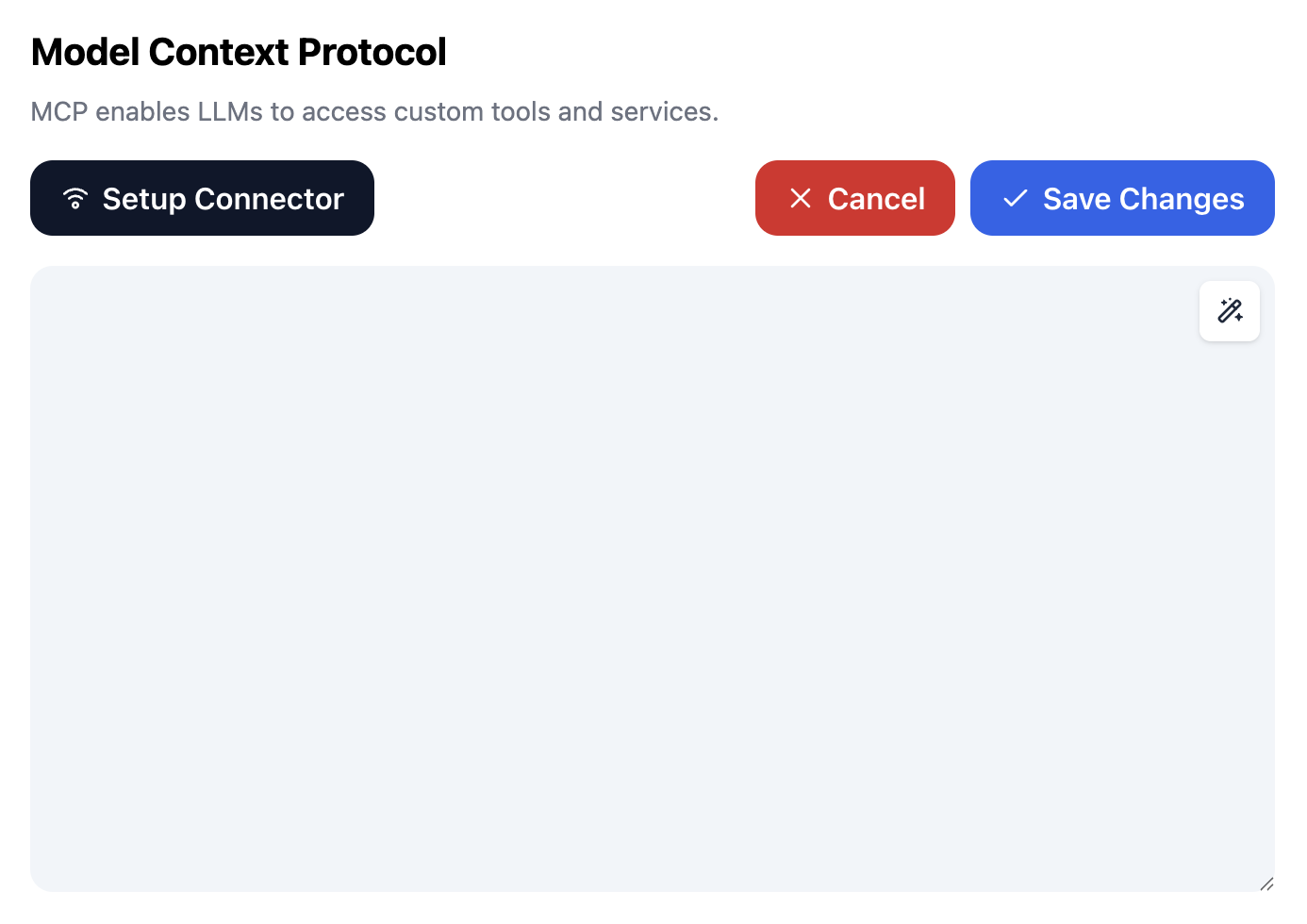
When the connector status is Ready, click Edit Servers and paste the MCP server configuration.

  1. Wait until the connector status shows Ready.
  2. Click Edit Servers.
  3. Paste the Voice MCP MCP server configuration.
  4. Save the server list.
  5. Refresh if you want to confirm the connector is still ready.
TypingMind MCP settings showing active server and Edit Servers button
{
  "mcpServers": {
    "voice-mcp": {
      "command": "npx",
      "args": [
        "-y",
        "voice-mcp"
      ]
    }
  }
}
4

Use it across models

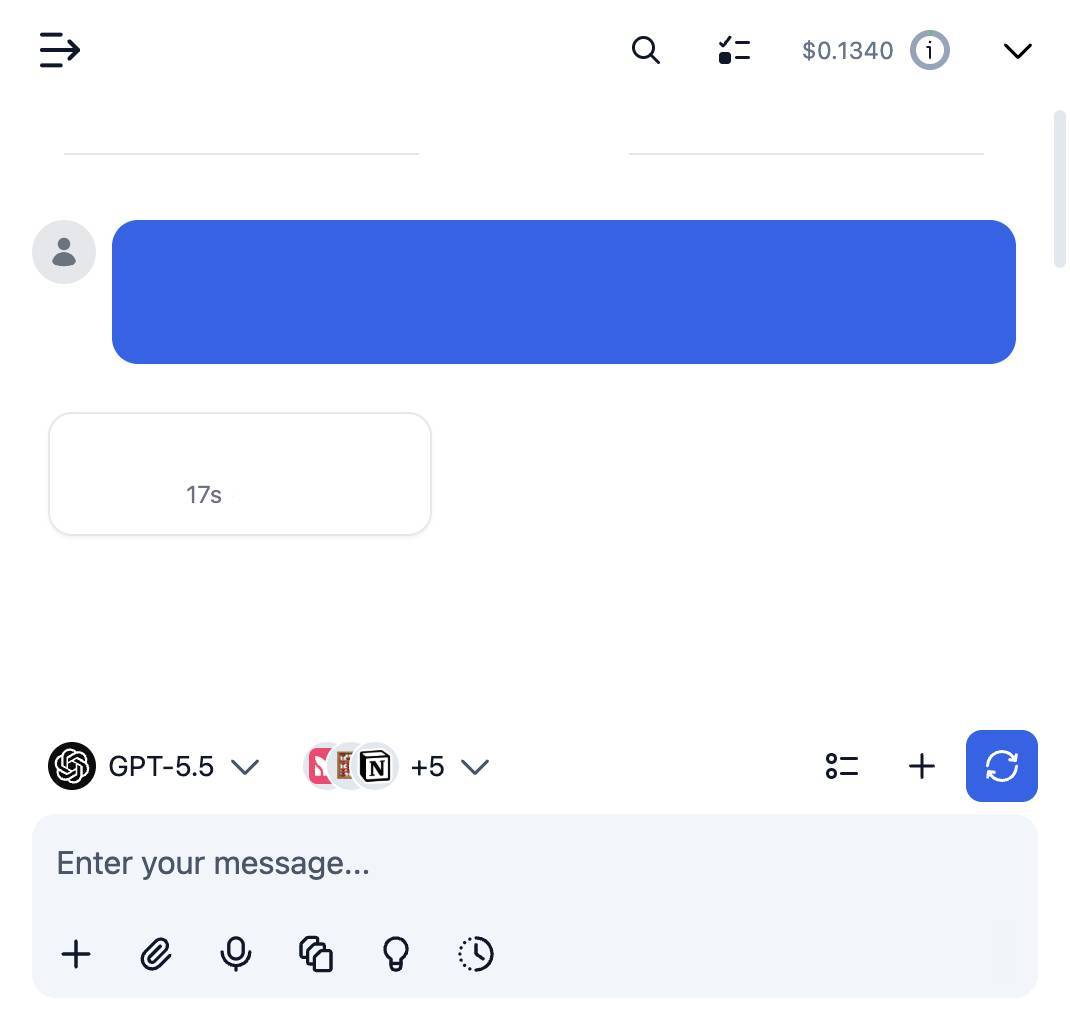
Save the server list, open Plugins, enable the Voice MCP MCP tools, then select any supported AI model in TypingMind and use the tools in chat or assign them to an AI agent.

  1. Open the Plugins page in TypingMind.
  2. Enable the Voice MCP MCP tools.
  3. Start a chat and choose the AI model you want to use.
  4. Use the MCP tools in chat or assign them to an AI agent.
  5. Switch to another AI model whenever needed without reconnecting MCP.
TypingMind chat using enabled MCP tools with a selected AI model
Can you use Voice MCP to help me with this task?
Voice MCP
Sure. I read it.
Here is what I found using Voice MCP.

Frequently asked questions

What is the Voice MCP MCP server used for?

Voice MCP is an MCP server that lets compatible AI clients connect to external tools and context. In TypingMind, you can add this MCP server once and make its tools available in your AI workspace.

Can I use Voice MCP MCP with multiple AI models in TypingMind?

Yes. TypingMind connects MCP tools at the workspace level, so you can use Voice MCP with different AI models such as Claude, ChatGPT, Gemini, or other models you have configured in TypingMind without setting up the MCP server separately for each model.

Why use Voice MCP MCP with TypingMind?

TypingMind is one of the best frontends for LLM chat because it brings multiple AI models, prompts, plugins, AI agents, API keys, and MCP tools into one workspace. With Voice MCP connected, you can use its MCP tools across your preferred models while keeping your chat workflow organized in TypingMind.

How do I connect Voice MCP MCP to TypingMind?

Voice MCP runs through the TypingMind local MCP connector. This is best when the MCP server needs access to local files, desktop apps, command-line tools, or private resources on your computer.

What tools does Voice MCP MCP provide in TypingMind?

Voice MCP exposes MCP capabilities that can be enabled from the TypingMind Plugins page and used in chat or assigned to AI agents.

Do I need to share my API keys with TypingMind to use Voice MCP MCP?

No. TypingMind is local-first and lets you keep your model providers, API keys, prompts, and MCP configuration under your control. If Voice MCP requires authentication, add the required headers, OAuth settings, or local configuration for that MCP server when you create the connection.

Related MCP Servers

View all

Set up your own AI workspace now

Get notified about new features and future giveaways by subscribing to our newsletter 👇