
Theta Health
CommunitySeamlessly connect your health data with AI assistants using Theta Health MCP Server. This server implements the Model Context Protocol (MCP) to let AI tools access and manage medical, functional, and device-generated health records. It offers features to retrieve diverse health information such as lab results, physical exams, device metrics, and user profiles, enabling smarter health data interactions. Designed for ease of integration, Theta Health MCP Server empowers AI applications to work efficiently with comprehensive health data, enhancing personalized insights and healthcare management.
| Publisher | theta4ai |
| Repository | theta-health-mcp |
| Language | TypeScript |
| Forks | 0 |
| Stars | 672 |
| Available tools | 21 |
| Transport type | stdio |
| Categories | |
| License | MIT |
| Links |
- Connect tools to AI workflows
Theta Health exposes MCP capabilities that can be used by compatible AI clients and agents.
- 21 available tools
Browse the callable actions below, including names and descriptions when provided by the server.
- Ready-to-copy setup
Use the installation snippets to configure this server in your preferred MCP client.
- Open source signals
672 stars and 0 forks from the linked repository.
Installation
Node.js 18+
{
  "mcpServers": {
    "Theta Health": {
      "command": "npx",
      "args": [
        "-y",
        "theta_health_mcp"
      ]
    }
  }
}
Available Tools
- get_genetic_data
Retrieve variant information by rsid, with optional lookup of nearby related variants.
- get_health_indicator
Get user health indicator data. This is the primary and most powerful tool for retrieving health metrics. It supports fuzzy search, time range filtering, and exclusion of specific indicators to provide precise results.
- get_journal_entries
Get journal entries for specified dates Retrieves user journal content for the specified dates from th_messages. Returns either text content or voice transcription, whichever is available. Returns fields include:
- date: Journal date
- content: Journal content (either text or voice transcription)
- content_type: Content type ('text' or 'voice')
- search_medical_literature
[Coarse Search] Batch search for medical literature with pagination, used for preliminary filtering. Returns basic metadata of multiple articles (title, abstract, authors, affiliations, etc.), WITHOUT full text. Use case: Discover relevant literature by keywords, perform initial screening based on abstracts and metadata. To get the complete full text of a specific article, use get_article_by_pmcid() for precise retrieval.
- get_indicators_by_symptoms
Get health indicators based on symptoms using LCS similarity and LLM matching
- get_user_health_profile
Get user health profile information Retrieves comprehensive health profile data from health_user_profile_by_system table.
- generate_column_chart
Generate a column chart, which are best for comparing categorical data, such as, when values are close, column charts are preferable because our eyes are better at judging height than other visual elements like area or angles.
- generate_dual_axes_chart
Generate a dual axes chart which is a combination chart that integrates two different chart types, typically combining a bar chart with a line chart to display both the trend and comparison of data, such as, the trend of sales and profit over time.
- generate_line_chart
Generate a line chart to show trends over time, such as, the ratio of Apple computer sales to Apple's profits changed from 2000 to 2016.
- generate_pie_chart
Generate a pie chart to show the proportion of parts, such as, market share and budget allocation.
- generate_radar_chart
Generate a radar chart to display multidimensional data (four dimensions or more), such as, evaluate Huawei and Apple phones in terms of five dimensions: ease of use, functionality, camera, benchmark scores, and battery life.
- get_clinical_trials
Get clinical trials information from ClinicalTrials.gov API. This tool searches for clinical trials based on provided keywords and status filters. It retrieves information about clinical trials in various states. The returned data includes:
- Trial title and NCT ID
- Sponsoring organization
- Trial status and status verification date
- Medical conditions being studied
- Brief summary of the trial
- Direct link to the trial on ClinicalTrials.gov Useful for:
- Finding clinical trials for specific conditions or treatments
- Researching available trials for patients
- Understanding current medical research activities
- Identifying recruiting trials for specific diseases
- download_global_files
Download file content from user's upload history and save to workspace. This tool works in conjunction with list_global_files tool:
- First use list_global_files to get available file IDs
- Then use this tool with those IDs to download files to workspace
- Use read_file tool to access the downloaded files The tool supports two modes:
- Local files (localhost URLs): reads from local storage using file_key
- Remote files: downloads via HTTP/HTTPS Files are saved to /workspace/downloads/ directory.
- get_drug_synergistic_interactions
Get synergistic interactions for a specific drug.
- get_fda_drugs
Get FDA approved drug information from the FDA database. This tool retrieves information about drugs approved by the U.S. Food and Drug Administration (FDA). You can filter by approval date range to find drugs approved during specific time periods. The returned data includes:
- Drug name and active ingredient
- FDA approval date and year
- Approved medical use/indication
- Drug identification number Useful for:
- Finding recently approved drugs for specific conditions
- Researching drug approval history
- Identifying new treatment options
- Understanding FDA-approved uses for medications
- get_user_medications
Get user's current medications from series data.
- get_food_records
Get user food records
- search_knowledge_qa
Search knowledge base for relevant Q&A pairs using semantic similarity. Supports parallel multi-keyword search with automatic deduplication. Features:
- Semantic search using embedding similarity
- Automatic parallel search for space-separated keywords
- Deduplication and ranking by similarity score
- Formatted output ready for agent consumption
- _deduplicate_and_sort_results
去重并排序搜索结果 去重策略:
- 基于 question 字段去重
- 如果同一个问题出现多次,保留相似度最高的
- get_medical_devices
Get FDA approved medical device information from the FDA database. This tool retrieves information about medical devices approved by the U.S. Food and Drug Administration (FDA). You can filter by approval date range and device category to find specific devices. The returned data includes:
- Device name and identification
- Device category/classification
- FDA approval date Useful for:
- Finding recently approved medical devices
- Researching device approval history by category
- Identifying new medical technologies
- Understanding FDA-approved medical devices for specific applications
- get_article_by_pmcid
[Precise Query] Retrieve complete information for a single article by PMCID, INCLUDING full text. Used for in-depth analysis of articles filtered from search_medical_literature() coarse search. Use case: Read full paper content, extract detailed information such as study methods, results, conclusions for fine-grained screening. Typical workflow:
- Use search_medical_literature() to search for relevant literature, get article list
- Perform initial filtering based on title, abstract, keywords, etc.
- Use this method get_article_by_pmcid() to retrieve the complete full text of target article
- Extract detailed information from full text (e.g., study population characteristics, methodology, specific data)
Use Theta Health MCP with multiple AI models
TypingMind connects MCP tools at the workspace level, so once Theta Health is connected, you can use it with different AI models in TypingMind instead of setting it up separately for each model. This MCP runs locally through the TypingMind MCP connector on your device.
Setup guide to use the local connector
Use this when the MCP server needs access to local files, apps, or private resources on your computer.
Open the MCP settings
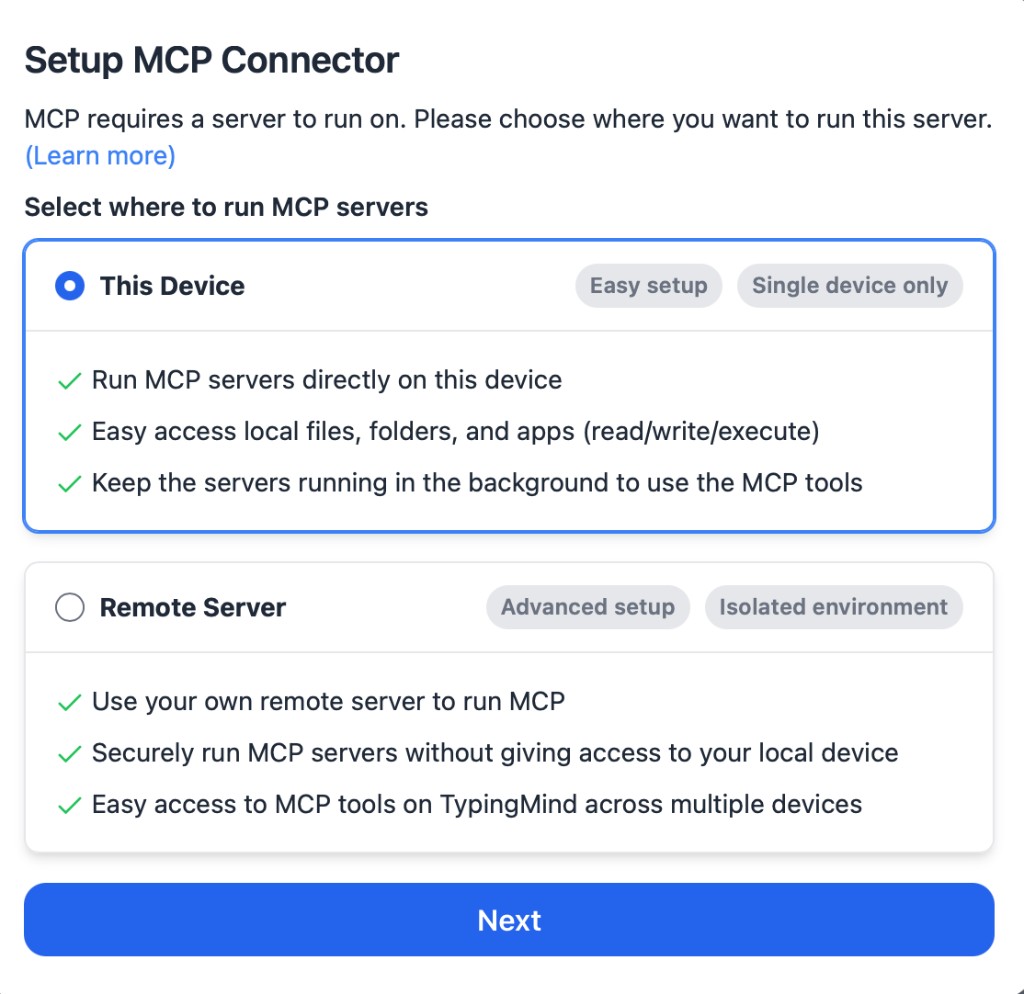
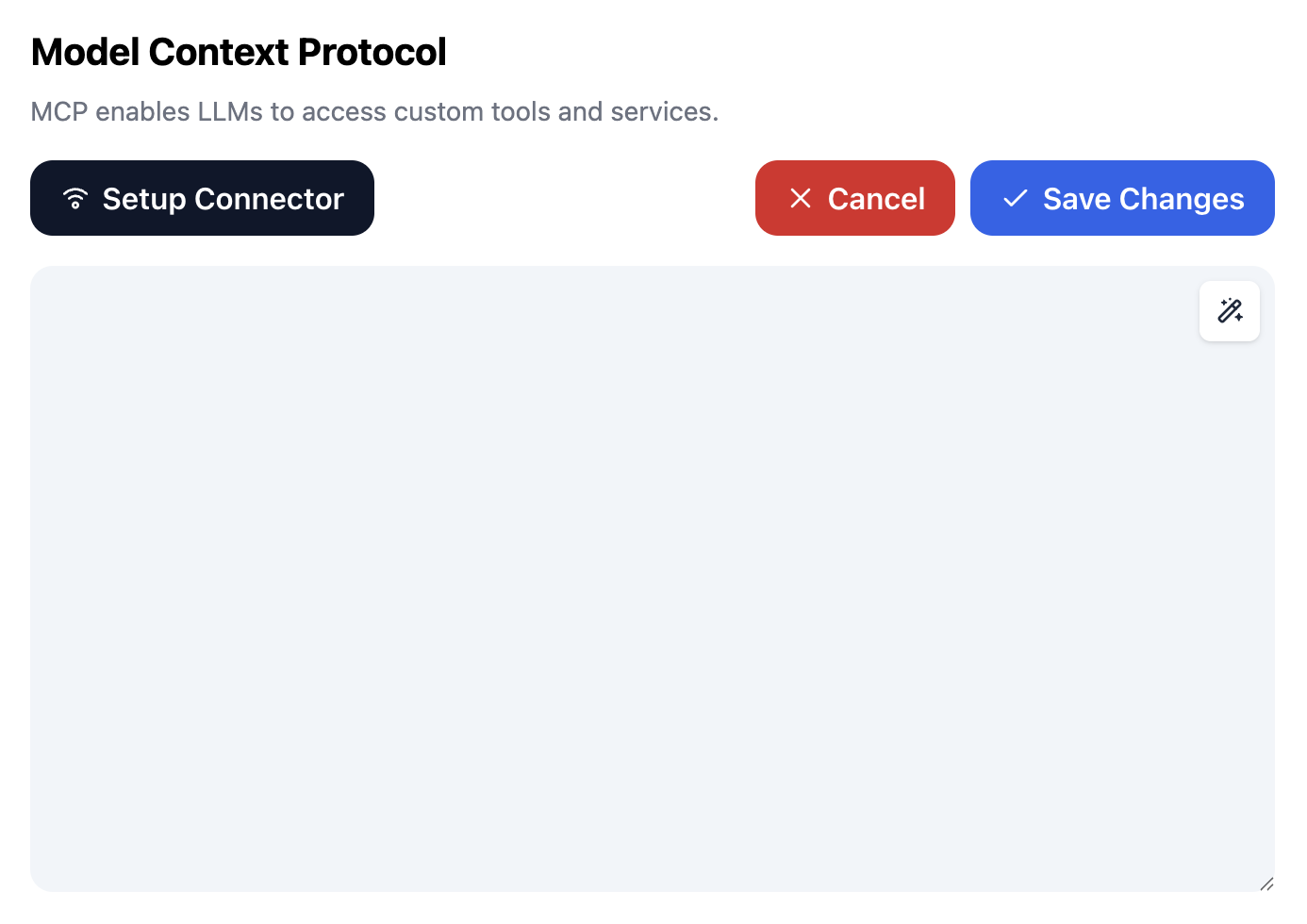
In TypingMind, go to Settings, Advanced Settings, then Model Context Protocol and choose Setup Connector.
- Open TypingMind in your browser.
- Click the Settings icon.
- Go to Advanced Settings.
- Open the Model Context Protocol section.
- Click Setup Connector and choose This Device.
Run the connector command
Choose This Device, copy the command from TypingMind, and run it in Terminal. Keep the process running while you use MCP.
- Copy the setup command shown by TypingMind.
- Open Terminal on macOS or Windows Terminal on Windows.
- Paste and run the command.
- Approve the package install if Terminal asks you to proceed.
- Keep the Terminal window running while using MCP tools.
Add Theta Health as a server
When the connector status is Ready, click Edit Servers and paste the MCP server configuration.
- Wait until the connector status shows Ready.
- Click Edit Servers.
- Paste the Theta Health MCP server configuration.
- Save the server list.
- Refresh if you want to confirm the connector is still ready.
{
  "mcpServers": {
    "theta-health": {
      "command": "npx",
      "args": [
        "-y",
        "null"
      ]
    }
  }
}Use it across models
Save the server list, open Plugins, enable the Theta Health MCP tools, then select any supported AI model in TypingMind and use the tools in chat or assign them to an AI agent.
- Open the Plugins page in TypingMind.
- Enable the Theta Health MCP tools.
- Start a chat and choose the AI model you want to use.
- Use the MCP tools in chat or assign them to an AI agent.
- Switch to another AI model whenever needed without reconnecting MCP.

Here is what I found using Theta Health.
Frequently asked questions
What is the Theta Health MCP server used for?
Theta Health is an MCP server that lets compatible AI clients connect to external tools and context. In TypingMind, you can add this MCP server once and make its tools available in your AI workspace.
Can I use Theta Health MCP with multiple AI models in TypingMind?
Yes. TypingMind connects MCP tools at the workspace level, so you can use Theta Health with different AI models such as Claude, ChatGPT, Gemini, or other models you have configured in TypingMind without setting up the MCP server separately for each model.
Why use Theta Health MCP with TypingMind?
TypingMind is one of the best frontends for LLM chat because it brings multiple AI models, prompts, plugins, AI agents, API keys, and MCP tools into one workspace. With Theta Health connected, you can use its MCP tools across your preferred models while keeping your chat workflow organized in TypingMind.
How do I connect Theta Health MCP to TypingMind?
Theta Health runs through the TypingMind local MCP connector. This is best when the MCP server needs access to local files, desktop apps, command-line tools, or private resources on your computer.
What tools does Theta Health MCP provide in TypingMind?
Theta Health exposes 21 MCP tools that can be enabled from the TypingMind Plugins page and used in chat or assigned to AI agents.
Do I need to share my API keys with TypingMind to use Theta Health MCP?
No. TypingMind is local-first and lets you keep your model providers, API keys, prompts, and MCP configuration under your control. If Theta Health requires authentication, add the required headers, OAuth settings, or local configuration for that MCP server when you create the connection.
Related MCP Servers
View all
Google BigQuery
Google 💚 MCP

MCP Server Chart
🤖 A visualization mcp & skills contains 25+ visual charts using @antvis. Using for chart generation and data analysis.

Excel File Manipulation
A Model Context Protocol server for Excel file manipulation

Vizro
Vizro is a low-code toolkit for building high-quality data visualization apps.
